
Get to know all about the Ex-Works price (EXW) Incoterms: definition, buyer vs seller duties, cost of exporting, importing and useful hints on how the buyer assumes responsibility for logistics i international trade success.
Introduction
Imagine the following situation: A textile producer in Guangzhou gets an order from a European retailer. The buyer requests a quote, and the manufacturer quotes him an Ex-Works price of $15,000. In three weeks, at the time when the goods become ready to be collected, confusion arises. Who makes the truck to deliver goods out of the factory? Who does the export customs clearance and export documentation? Who finances the work of customs clearance? This situation occurs in international trade every single day, which underscores the importance of knowing Ex-Works pricing as an exporter and importer.
Ex works (EXW) is the simplest form of pricing that is applied in international trade and in which the seller is responsible for determining the cost of goods at the door of the factory. It is where all other shipping arrangements begin, and it is certainly the most seller-commodious of all the Incoterms. To companies that conduct international business, the knowledge of the EXW pricing would not only be beneficial but would also play a vital role in making correct cost calculations, risk management, and effective contract negotiations.
Regardless of whether you are an exporter and need to reduce your responsibilities or an importer and the base price is the most important to you, learning how to make use of Ex-Works pricing and the shipping process will make you feel much better about your bargaining position in international trade.
What is Ex-Works (EXW) Price?
Formal Definition
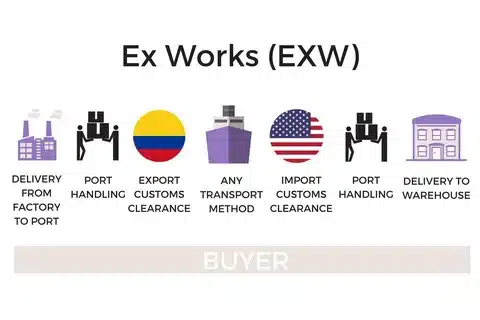
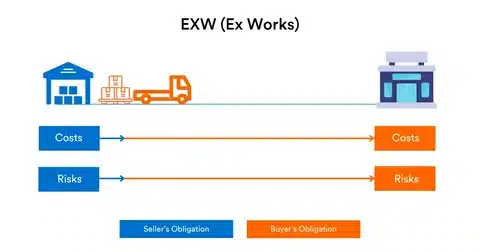
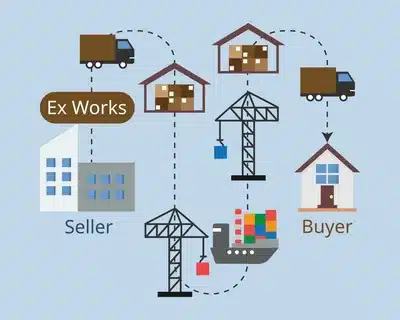
Ex-Works (EXW) is an Incoterm that is the least commitment made to the seller. Under the EXW-single-point agreement, the seller places goods at his facility (factory, warehouse, or any other location so named), which is known as the seller’s location, and the buyer is responsible for all the costs and risks incurred in transporting goods to the endpoint.
Key Components Included in EXW Price
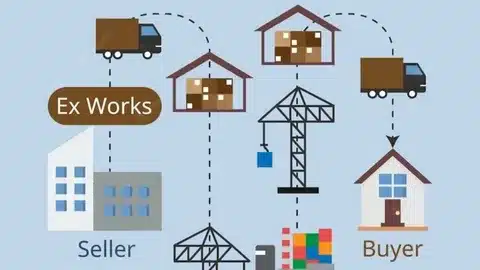
Ex-Works price normally covers various costs, including terminal charges :
- Information and materials.
- manufacturing or production expenses.
- Packaging plus quality control.
- Cost of labor to the completion.
- Overheads of the factory and administrative expenses.
- Seller’s profit margin
- The delivery of goods to the specified field.
What EXW Price Does NOT Include
More importantly, the Ex-Works price omits additional costs such as shipping costs :
- Delivery to the location of the seller.
- Export licenses and documents.
- Customs clearance operations.
- loading costs (not agreed on)
- Insurance coverage
- Import duties and taxes
- Any expenses after the factory gate.
Comparison with Other Incoterms
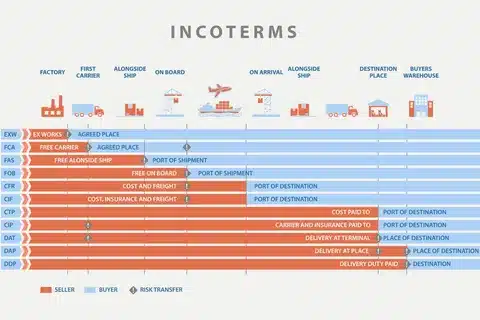
It is easier to understand EXW and its shipping terms compared to other common Incoterms:
| Incoterm | Seller’s Obligations | Transport Costs | Export Clearance | Risk Transfer |
| EXW | Minimum – goods ready at premises | Buyer pays all | Buyer handles | At factory |
| FOB | Deliver to port, export clearance | Buyer pays ocean freight | Seller handles | Ship’s rail |
| CIF | FOB + insurance + freight | Seller pays to the destination port | Seller handles | Ship’s rail |
| DDP | Maximum – delivered, duty paid | Seller pays all | Seller handles | Final destination |
How Ex-Works Price is Used in Practice
Exporter Pricing Calculations
EXW is a method of calculation that exporters use as their base. This is the way a manufacturer usually lays out his EXW quotes, sometimes also using the free on board term :
Base EXW Calculation:
- Direct materials: $8,000
- Direct labor: $2,500
- Factory overhead: $1,500
- Administrative costs: $800
- Profit margin (15%): $1,950
- Total EXW Price: $14,750
Buyer vs Seller Responsibilities Under EXW
Seller Responsibilities:
- Deliver commodities that meet contract requirements.
- Bring about the goods at the agreed point.
- Present the commercial invoice and any other delivery documentation needed.
- Help the buyer with export papers (at his cost)
- Provide the buyer with notice of the goods being ready to be collected.
Buyer Responsibilities:
- Arrange transportation of all from the seller’s premises and cover all the transportation costs.
- Choose clearance and documentation of exports.
- Get export licenses as necessary.
- Arrange insurance coverage
- Carry all risks from the time goods are made available.
- Pay all expenses of taking delivery.
Industry-Specific Examples
Manufacturing Sector: An electronic producer in Shenzhen gives a quote of EXW 50,000 on 1,000 smartphones. The buyer will be required to make pick up, export clearance using the buyer’s designated method, shipping to Hamburg, import duty, and ultimately deliver the goods-which can add up to $15,000-20,000 to the price paid.
A coffee exporter in Vietnam is selling green coffee beans at EXW $4.50/kg. The foreign consumer needs to make arrangements with a shipping company and freight forwarders with regard to packaging, export licenses, sea transport, and importation processes, which may increase the landed price by a factor of two.
Textile Industry: EXW Garment manufacturer charges EXW $12/piece of 5,000 t-shirts. The fashion retailer must consider pickup charges, export paperwork, freight, and duty charges in determining their overall cost of purchase.
Common Misunderstandings
Mistake 1: Giving the impression that EXW is to include loading. Many buyers assume that both the buyer and seller have to load goods onto trucks. But this is not something that EXW needs unless it is agreed upon.
Mistake 2: Confusion on export documentation. Buyers can occasionally believe that sellers can take care of export documents. In pure EXW conditions, it is the duty of the buyer.
Error number three: Risk transfer timing. Risk is transferred to the buyer when goods are available, not when they are collected or shipped.
Advantages and Disadvantages of Using EXW
Advantages for Sellers
Minimal Risk Exposure: Sellers pass the risk at the point in time when goods are ready at their location.
Streamlined Operations: You do not need to organize transportation, export processes, or international logistics.
Cost Predictability: Service providers no longer have to fear changing lorry prices because of changing freight prices or exporting issues.
Administrative: Efficiency: Fewer paperwork and documentation requirements.
Advantages for Buyers
Maximum Control: Full control of transportation modes, routes, and logistics providers.
Cost Transparency: Open pricing can enable buyers to go out and get the best logistics solutions.
Consolidation Opportunities: EXW Consolidation Buyers may combine several shipments, which can be done through consolidation, to save per-unit transportation costs.
Disadvantages for Sellers
Minimal Market Acceptability: A large number of buyers will favour more accommodating terms such as FOB or CIF.
Export Complexity: Could be asked to deal with export processes without payment to buyers.
Competitive Disadvantage: Rivalry that provides FOB or CIF terms can seem better than the one being evaluated.
Disadvantages for Buyers
Greater Complexity: Buyers are required to take care of every form of international logistics and paperwork.
Increased Overall Costs: More logistics and administrative costs may be high.
Risk Concentration: All risks are taken by buyers between the factory gate and end destinations.
Export Compliance: The buyer has to know and adhere to the country’s export regulations imposed by the seller.
Risk Mitigation Strategies
For Sellers:
- Properly define what is and is not included in contracts under EXW.
- Provide help in export procedures on a cost-plus basis.
- Give elaborate pick-up instructions and facility details.
- Take other Incoterms into consideration.
For Buyers:
- Use reputable freight forwarders in the country of the seller.
- Know the local export requirements and limitations.
- Get a full insurance cover.
- Establish a good relationship with logistics providers.
- Include all other expenses in pricing estimates.
Legal and Trade Regulation Aspects
Internal Tax Handling Under EXW
Internal taxes are a special case under EXW conditions:
VAT/GST Treatment: In most countries, goods sold EXW abroad can be tax-exempt or zero-rated; however, this cannot be so unless suitable export documentation is undertaken.
Excise Duties: EXW, some products that are excised may have to be handled with special care, because the buyer is obligated to treat the products in the proper manner.
Tax Documentation: Sellers are expected to keep a record that goods have actually been exported to justify any claim of tax exemption.
EXW and Incoterms 2020
Incoterms 2020 still use EXW, but with some notable exceptions:
Security-Related Costs: There are security clearances, and costs are distributed among the parties, with the requesting party incurring the costs.
Transport Document Requirements: Elaborated on the fact that sellers are not required to deliver transport documents unless otherwise.
Loading Obligations: Confirmed that EXW does not result in sellers loading goods, but this should be specified in the contract with the seller.
Regional and Customs Considerations
EU Specific Rules:
- Export declarations are to be submitted within a certain period of time.
- Both parties may need to have EORI numbers.
- The recourse to VAT differs according to the member state.
Documentation Requirements:
- Commercial invoices have to contain certain information.
- Contents and weights should be described on packing lists.
- Preferential treaties might demand certificates of origin.
Customs Compliance:
- Buyers should make sure that they classify goods appropriately.
- Export control laws have to be adhered to.
- Some products might need end-use certificates.
Practical Tips for Businesses
What Exporters Should Specify in EXW Contracts
Location Clarity: Designate specific pickup location, building, dock, or warehouse information.
Timing Requirements: Establish business hours, notice schedule, and any limitation on pickup times.
Loading Arrangements: Is a statement of whether loading is included or not, and equipment requirements.
Documentation Support: Provide details of documents that will be used, and there will be any support that will assist in export processes.
Inspection Rights: Establish the conditions and time under which buyers can have access to check goods before they receive them.
Buyer’s EXW Checklist
Pre-Purchase:
- Export requirements of the research exporter in the country.
- Find trusted freight forwarders and logistics agents.
- Know overall landed cost implications.
- Check the capacity to deal with export papers.
Contract Stage:
- Explain the pick-up point and process.
- Assure what documents the seller is going to provide.
- Determine delivery schedules and notice.
- Determine the inspection and acceptance processes.
Execution Phase:
- Make transport and export clearance arrangements.
- Schedule a pickup with the seller.
- Make sure there is adequate insurance cover.
- Track the shipment and paperwork.
Comparing Offers Using Different Incoterms
Because comparing quotes that have varying Incoterms is a complicated process, develop a standardized comparison:
EXW $10,000 + estimated logistics costs of 4,500 = total FOB amount of $12,000 + ocean freight charges of 2,200 = total CIF amount of $13,800 + import tax of 1,100 = total amount of 14,900.
This will show the real cost implications of individual options.
Working with Freight Forwarders
Selection Criteria:
- Knowledge of the country where you are selling and your market of destination.
- Local partnership and network coverage.
- Monitoring technology and equipment.
- Affordable prices and services.
Service Expectations:
- Export registration and clearance.
- Coordination of pickup and transport.
- Risk management and insurance advice.
- Tracking and updates of the shipment in real time.
Frequently Asked Questions
Does the EXW Works price include export duty?
No, export duties and taxes are not included in the EXW price. All the expenses and procedures related to the export, including the possible export duties, are covered by the buyer. Nonetheless, export duties on manufactured goods are not levied by many countries, and instead, these countries charge import duties.
Who bears insurance responsibility under EXW?
Under EXW, the buyer has full responsibility in terms of insurance. When goods are sold at the premises of the seller, the risk is transferred to the buyer, and thus the buyer must have detailed insurance cover to the final destination.
Can the buyer collect goods directly from the factory, or must the seller deliver somewhere?
In the EXW terms, the buyer usually receives the goods on the territory of the seller (seller is a factory, a warehouse, and so on). The buyer is bound to receive the goods at the location of the seller and not elsewhere. Parties may, however, agree to changes in their contract.
How is risk transferred under EXW?
Risk is transferred between the seller and buyer when goods are put into the possession of the buyer at the disposal of good at the premise of seller. It is taking place in situations where the goods are available to collect and the buyer has been informed when the collection has not yet taken place.
What happens if goods are damaged at the seller’s premises before pickup?
In case of damage to goods before they are delivered to the buyer, the seller is held responsible. But, when the goods are ready and the buyer has been notified, the risk becomes shared with the buyer even if he delays to pick-up.
Can EXW be used for any mode of transport?
Yes, EXW can be applied to all modes of transportation, and it can be multimodal transportation. This is especially typical in those cases when buyers desire the most possible influence on logistics planning.
Conclusion
Ex-works pricing is the basis of an ex-works agreement in international trade pricing that gives the greatest flexibility to buyers and the least exposure and risk to the seller’s factory. The knowledge of EXW terms is crucial when you are either a manufacturer trying to ease your export process or an importer interested in having the lowest base prices for your products. The buyer bears the cost.
Proper planning, proper communication, and realistic cost planning are the keys to successful EXW transactions. Sellers should be able to explicitly state what is and is not included in their EXW price, whereas buyers should be able to budget and cover all the additional expenses between the factory gate and the final destination free carrier.
It is essential to keep in mind that the selection of the appropriate Incoterm will be based on your circumstances: whether you have experience in trading internationally, whether you develop relations with logistics providers, whether you are a risk-taker or not, and whether you are capable of performing your functions. Although EXW has some benefits, it might not always be the most economically feasible option to use in every transaction.
Considering the terms of EXW before committing, it is best to seek advice from an experienced professional in the field of logistics who can enlighten you on the full implications and also make sure your international trade dealings go well. Proper planning and professional guidance can be rewarded by the lack of complications and low costs, optimizing the buyer’s responsibility.