Introduction
As eCommerce brands begin to scale, fulfillment becomes their largest operational bottleneck very fast. Inventory control, order handling, and delivery delays may be overwhelming the internal teams, with resulting delays, mistakes, and missed revenues. This is more so where businesses have to deal in wholesale customers who demand in bulk deliveries which are to be done with accuracy.
In this all-inclusive guide, we will deconstruct the meaning of B2B fulfillment, its functionality and why it is critical in expanding eCommerce brands. Regardless of whether you are sourcing goods abroad or entering new markets, the knowledge of B2B fulfillment can turn your business organization into a disorganized mess or make it a smooth sailing ship. We shall also discuss how the service providers such as BM Supply Chain, a top 3PL provider in China, are able to make global scaling affordable and effective.
What Is B2B Fulfillment?
B2B fulfillment is the complete process of warehousing, handling and transportation of large orders between companies. As compared to the transactions that are consumer-facing, it can include higher volumes, custom packaging, and complicated logistics to satisfy the needs of wholesale purchasers, retailers, or distributors.
Essentially, B2B fulfillment meaning is concerned with optimality in supply chains that are business-to-business. It also makes the products flow smoothly out of warehouses and to the clients, which may include third-party logistics (3PL) that can do the heavy lifting. In the case of eCommerce brands, this implies outsourcing some operations such as inventory management and order delivery with the objectives of engaging in the main activity of product development and marketing.
In other words, what is B2B fulfillment? It is the support behind wholesale business, which minimizes the risk of high-volume shipping. As an example, BM Supply Chain focuses on the B2B fulfillment operations in China, using the best sourcing, quality inspection, and provisioning services to ship goods to other parts of the world.
B2C fulfillment, in contrast, addresses consumer orders: individual orders, e.g. single-item orders at an online store. B2B, in its turn, necessitates stronger systems to support pallets or containers making it comparatively more complex yet also scalable to those brands that are planning to grow.
Step-by-Step Process: How B2B Fulfillment Works
The value of B2B fulfillment works can be understood by understanding the process. It usually occurs in a sequence of interrelated processes, which are aimed at eliminating as many mistakes as possible and maximizing speed. Here’s a breakdown:
1. Product Sourcing or Inventory Receiving
The process starts with the purchase of goods. eCommerce brands purchase goods directly at manufacturers or the receiving of stock deliveries to the fulfilling center. This phase involves the verification of quantities, damages, and the documents of the items into the warehouse management system (WMS).
In the case of brands that make use of B2B fulfillment services in China, this can sometimes result in accessing huge supplier networks. The example of BM Supply Chain is the combination of sourcing and fulfillment in which clients can purchase raw materials or finished products without any problems.
2. Quality Inspection & Storage
Products once received are subjected to very strict quality checks to verify that it is up to standards. This could include testing batches, functionality-checking, or checking adherence to regulations.
Authorized products are then held in streamlined cargo warehousing. Innovative systems monitor the quantity of stocks so that they do not result in stocking up or running out of stock. Since the providers such as BM Supply Chain are offering up to 30 days of free storage space, the brands will have more time to manage cash flow without the urgent need to shift inventory.
3. Order Integration & Processing
Upon receiving a wholesale order (a large portion of which are received through integrated APIs or instantiated through a plug in) data is pulled out by the system. This contains the customer information, product SKUs as well as shipping preferences.
This is where automation comes in, which integrates with business eCommerce platforms such as Shopify or Amazon. B2B fulfillment process allows the verification of the orders at a fast rate and raises issues such as low stock hence halting.
4. Pick, Pack & Ship
This is the action phase. Items are selected on shelves by warehouse employees or highly automated robots, packed safely (with custom packaging, custom labeling or kitting often), and ready to be shipped.
In the case of B2B, packaging may be in the form of pallets, wrappings of large products, or additional services such as labeling. The shipping will be on the basis of regular carriers or expedited services to the global arena depending on the client needs.
5. Real-Time Tracking & Delivery
Real-time after shipment tracking makes everybody aware. Customers use dashboards to get information about the status of the transit, estimated arrival, and delivery evidence.
This openness generates confidence particularly in global performance. The example of one-stop tracking query system of BM Supply Chain is the demonstration of how the modern 3PLs make it simplified and minimize disputes and increase reliability.
B2B vs B2C Fulfillment: The Key Differences
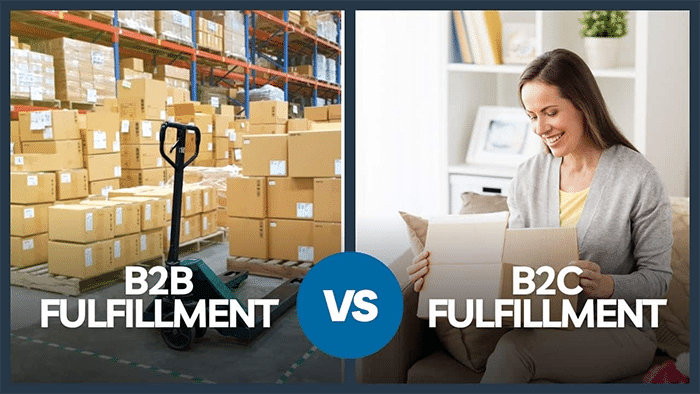
The models are very different as both B2B and B2C fulfillment focus on delivering products to end-users. B2B vs B2C fulfillment begins with volume of orders: C2B processes large orders (e.g. hundreds of items per order), C2C deals with small and personal packages.
The B2B packaging can be industrial, like crates and pallets, to be long lasting, unlike the B2C packaging, which can contain branding bells and whistles on consumer-friendly boxes. There is also a difference in inventory turnover; B2B could have slower turnover because of a bigger inventory that needs to be managed using an advanced B2B warehouse inventory.
The complexity of logistics increases in B2B, and requirements are related to the clearance of customs, shipment of freight, and the delivery of goods to various addresses. B2C, in its turn, focuses on speed in its last-mile delivery. With eCommerce fulfillment of wholesale brands, these variations imply that B2B needs to be more customized, such as assembly, or bundled, to endear oneself to business clients.
After all, B2B requires more coordination to sustain a relationship with a repeat buyer, thus professional 3PL partners are invaluable.
Benefits of B2B Fulfillment for eCommerce Brands
Making an investment in professional B2B fulfillment does have a real benefit, especially to a brand expanding across borders. To begin with, it enhances accuracy and consistency. The automatic systems minimize human mistakes during the picking and packing of goods so that wholesale clients get what they have ordered.
Another key attraction is a cost savings. Through outsourcing, brands reduce costs on storage, labor as well as shipping negotiation. In the direct effect of the bottom line, the providers such as BM Supply Chain have provided free warehousing time and efficient logistics.
Increased customer satisfaction is a logical outcome. Wholesale customers appreciate timely deliveries, which earn loyalty and make them repeat customers. In the case of eCommerce brands, it implies a better collaboration and a reduced number of returns.
The greatest advantage is possibly scalability. Fulfillment partners can deal with the surge with automation and in-time visibility as the orders rise. China 3PL fulfillment specifically takes advantage of the closeness to manufacturing centers and can do so with faster turnaround.
Other advantages consist of a range of diversified services, like one-piece dropshipping or personalized packaging, to enable brands to work towards expansion without trouble when it comes to operations.
How to Choose the Right B2B Fulfillment Partner
When picking a B2B fulfillment provider, it is not only about cost, it is about compatibility with what your brand wants. Begin with warehouse location; the closer to the suppliers such as in China, the lower are the transportation times and costs.
The API integrations play a major role in smooth flow of orders. Find the ones that will work with the free plugins that will be integrated directly with your eCommerce system so that it can process automatically.
Pricing is transparent and not a surprise. Check structures that have value-added services without any additional charges. In addition, determine competencies in other key domains, such as labeling, kitting, and custom packaging to respond to wholesale needs.
BM Supply Chain is unique in terms of 30 days free storage, high-quality WMS and international freight knowledge. Their complete end-to-end solutions can be sourcing, all the way to delivery, designed with eCommerce brands in mind.
BM Supply Chain is a reliable 3PL business partner in China that provides end-to-end B2B fulfillment services to international brands.
Case Study: Optimizing Operations with Chinese B2B Fulfillment
Suppose a medium-sized clothing Shopify-store has a problem with wholesale orders to retailers in Europe. Profits were being worn out by inventory mismatches and shipments that were late.
They collaborated with 3PL fulfillment in China by joining BM Supply Chain where they integrated their system through API, which allowed them to update their stocks in real-time. The flaws were identified during quality checks, and bulk orders were done through automated pick-pack tasks.
The result? The time to deliver was reduced by 40 percent, inventory accuracy improved to 99 percent, and customer satisfaction increased enormously. This enabled the brand to penetrate new markets without the need to employ internal employees, which demonstrates the effectiveness of the dedicated B2B fulfillment.
Conclusion
In the modern competitive environment of eCommerce, B2B fulfillment is a skill that cannot be negotiated by the brands that wish to pursue a sustainable development. This guide illustrates the empowerment of wholesale activities by the company through defining its main processes up to the realization of advantages, such as, cost-effectiveness and scalability.
Being a pioneer of 3PL services in China, BM Supply Chain adds to its knowledge of sourcing, storage, and international logistics that will guarantee the transparency and reliability throughout the entire process.
Get in touch with BM Supply Chain and streamline your B2B fulfilment in China as well as develop your brand internationally.