Introduction
Suppose such an eCommerce business that is already doing well with direct to consumer sales reaches the proverb, when it comes to negotiating with retailers to make bulk purchases. Then, all of a sudden, your previous warehouse configuration of the fast parcel delivery is no longer sufficient to accommodate pallet loads and scheduled deliveries. This trend of consumer-oriented activities to business relationships reveals a major gap in the logistics: B2B and B2C fulfillment.
And in the case of expanding brands, it is not merely theoretical but essential to learn these differences so as to be able to expand without losing your head. The step-by-step B2B fulfillment process from China serves the wholesale customers with bigger and more complicated orders whereas B2C remains focused on the rapid and individual delivery of the product to the end-user. The following guide de-packs the major differences in operations, logistics, and technologies, which can make you maneuver in both worlds.
The Core Difference
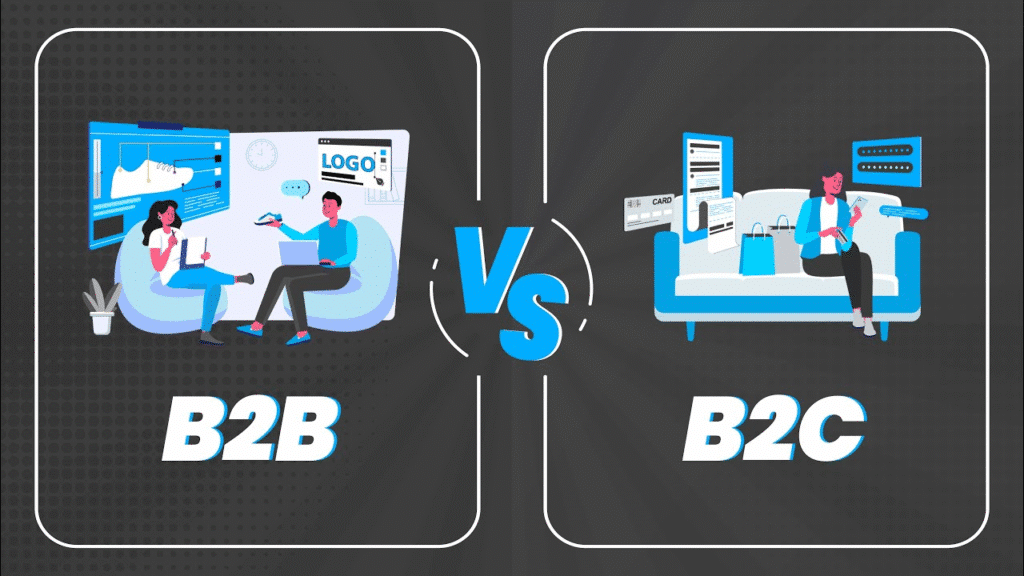
Down to its very core, the distinction between B2B and B2C fulfillment is reduced to serving who and how. B2B fulfillment deals with large orders to other businesses such as wholesalers or retailers. These tend to incorporate frequent orders, which have longer lead times, and cost-efficiency and reliability are more valued than speed.
B2C fulfillment, on the other hand, is aimed at individual customers, who receive smaller items by means of online stores. In this case, speedy industry delivery is the priority and a smooth customer experience that leads to repeat purchases and favorable reviews.
In a nutshell, B2B fulfillment is more efficient and on a large scale to facilitate business relations, but B2C fulfillment is more about speed and personalisation to satisfy consumers. This fundamental divide enables brands to stay separate in terms of workflows that might cause inefficiencies or mistakes.
Detailed Comparison
To establish the differences further, we shall venture into particular spheres of operation. B2B and B2C fulfilment demand their approaches, similar to the requirements of its categories, including processing orders to warehouses.
Order Volume and Frequency
B2B fulfillment has high volume and low frequency orders. A single delivery may have hundreds or thousands of units, and may be a long way ahead based on contracts or predictions. This enables a logistic planning but it demands a strong inventories to fulfill demand without delays.
However, B2C fulfillment involves low volumes and high frequency orders. A consumer may purchase a single or two products at random intervals resulting in a perpetual flow of choices and packs. This model is agile based and the systems are engineered to manage spikes such as holiday sales or flash promotions.
The wholesale fulfillment vs retail fulfillment aspect in this context is clear since B2B creates long-term collaborations with the constant supply of a certain volume of goods, whereas B2C manages to adjust to the uncertainty of consumer behavior.
Packaging and Labeling
In B2B packaging can be sturdy but standardized such as pallets or cartons designed to be transferred by freight. Labels concentrate on compliance: – think barcodes, batch numbers and regulatory information – to provide easy handoffs to business clients. Customization could be bundled or kitted.
In the case of B2C, the packaging reflects on the unboxing experience. Protective inserts, branded boxes, and eco-friendly materials make the customer more attractive. Labeling is less complicated, and usually only requires shipping addresses and basic tracking, although with a marketing insets or personal notes in mind.
This disparity highlights the reason why B2B warehouse management is more focused on durability and scalability, whereas B2C invests in beauty to generate brand loyalty.
Inventory Management
The inventory management that is based on B2B is dependent on long-term forecasting and storage. As the size of orders increases, it is possible to monitor the levels of stock at the warehouse level, where it is possible to predict demand based on business cycles. There is reduced turnover and hence space optimization and just in time restocking would avoid overstocking.
B2C requires dynamic and high turnover inventory management. The products are fast and they must be tracked instantly to prevent stock out at peak time. Sales data is often automated into the systems to do automated reordering and have the shelves responsive to trends in the consumer base.
This is seen in the processing of orders in B2B and B2C: B2B may do weekly batches, whereas B2C does it in real-time to fulfill promises of shipping in the same day.
Technology and Integration
B2B fulfillment technology is skewed to enterprise-level integrations such as API, EDI (Electronic Data Interchange) and ERP, powered by our ecommerce fulfillment integrations in China. Those bind producers, warehouses, and customers together to make the data flow smooth and invoices and order confirmation are automated.
B2C tech targets eCommerce like Shopify, WooCommerce, or Amazon. Plugins will allow the rapid synchronization of orders, inventory, and customer data, but the focus will be on convenient trackers in form of dashboards.
In the case of brands taking on B2B fulfillment of Chinese origin, advanced warehouse management systems (WMS) fill these gaps and make them compatible with models.
Shipping and Delivery
B2B shipping may also utilize such freight options as Less-Than-Truckload (LTL), Full Container Load (FCL), or bulk carriers. Deliveries are also organized to business docks, which have long transit time and low unit cost.
B2C uses couriers to deliver express and the last-mile services, i.e. UPS or FedEx leaving packages at the door. There is the speed king with the possibility of two-day service or even same-day service to fulfill the expectations of the consumers.
This difference in logistics indicates why B2B is able to make shipments consolidated, whereas B2C makes investments in networks to reach everybody as quickly as possible.
Customer Relationship and Support
The B2B relationships are contractual and queries, personalized requests and long term planning are dealt with by specific account managers. Support is based on reliability, such as active problem fixing to keep partnerships alive.
In B2C, customer support is reactive in nature and volume based as it handles returns, complaints, and enquiries by using chatbots or help desks. The idea is to achieve fast solutions to save personal satisfaction and online reviews.
They both need trust, and B2B achieves it with the help of consistency whereas B2C does it with personalization.
Why the Distinction Matters for eCommerce Brands
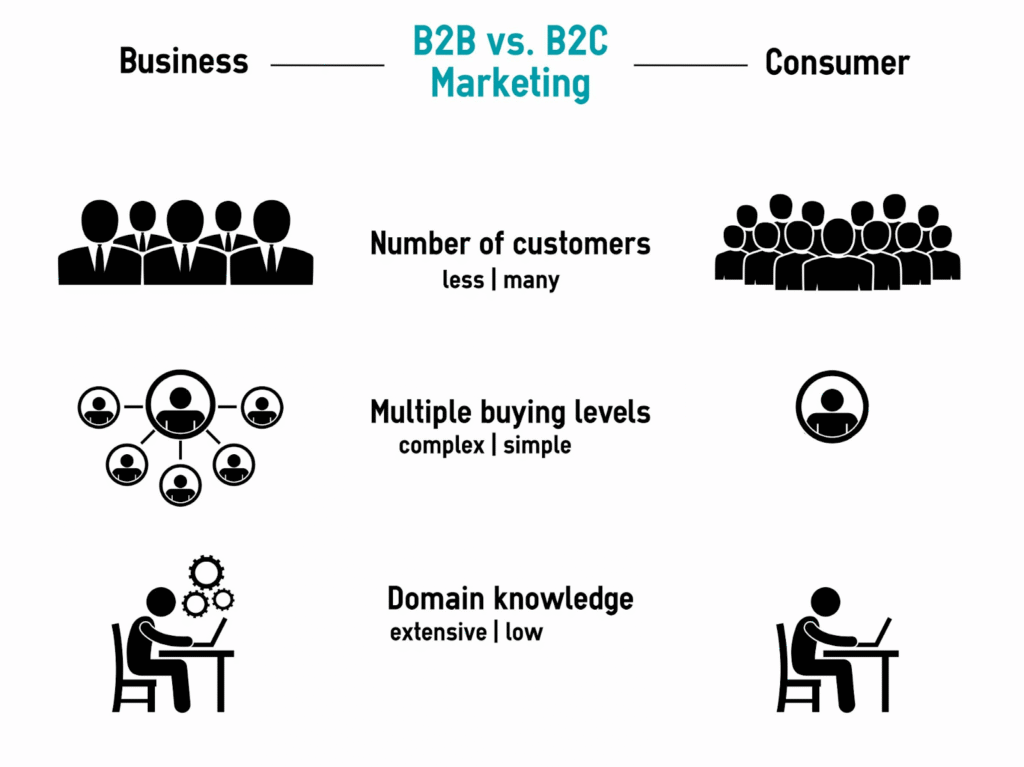
It is common today to find many eCommerce brands that operate dual B2B and B2C; meaning, they directly sell online at the same time that they provide retailers. Failure to observe the differences may result in wrong operations such as B2C packaging of B2B bulk which will lead to increased costs or spoilt goods.
Knowing these will streamline warehouse plans to use in dual purpose, automate delivery to reduce inaccuracy, and regulate the cost of logistics. A good example is the B2B fulfillment process that focuses on forecasting in order to lower holding costs whereas B2C fulfillment services focus on speed to lower cart abandonment.
With a global market, this knowledge allows smarter scaling. Cost benefits in B2B to achieve economies of scale in China coupled with B2C responsiveness to consumer needs may benefit brands of Chinese origin. It eventually leads to profitability since it aligns operations with the streams of revenues.
Challenges and Solutions in Managing Both Models
A combination of B2B and B2C does not come easy. There is a common problem that inventory synchronization fails when bulk B2B runs out of stock required to satisfy B2C spike. The integration of APIs can be a difficult task, and EDI introduced by B2B does not coincide with B2C and the simplicity of its add-ons.
Another problem is warehouse allocation, should it be allocated to pallets or small parcels. Without unification of systems, order accuracy will be compromised and chances of mix-ups during processing are high.
The way out is to find high-capacity 3PL providers. BM Supply Chain is a top China 3PL fulfillment partner, which addresses them by having one WMS monitoring real-time inventory in models.The cash flow is facilitated by easy 30-day free warehousing, and the API is integrated smoothly across various platforms.
One-stop tracking and value-added-services such as custom labeling make BM transparent and efficient, allowing the brands to grow without operational silos.
How BM Supply Chain Bridges B2B and B2C Fulfillment
BM Supply Chain is doing well in integrating B2B and B2C into a single seamless system with our B2B fulfillment services from China. They are a leading supplier in China and, therefore, can rely on high-quality supplier chains to procure goods, audit quality, and control end-to-end fulfillment.
With B2B, they are involved in bulk order management involving palletized shipping and scheduled deliveries with the help of sophisticated forecasting tools. B2C benefits from accurate pick and pack fulfillment services in China, which can be combined with platforms such as Shopify and Amazon to make quick and accurate dispatches.
Its main characteristics are 30 days of free storage to cushion the inventory pressures, free APIs and plugins to allow easy docking, and a variety of services such as assembly or a custom packaging. This system is very cost effective and increases reliability be it wholesale or retail.
BM Supply Chain offers a full China fulfillment offering whether you have a growing D2C brand or you are operating your business in the wholesale sector.
Conclusion
Going through B2B and B2C fulfillment entails acknowledging that both are crucial in implementing eCommerce, but all require different workflow- one focused on volume and collaborations, and the other is on expediency and consumer satisfaction. Through the ability to master these differences, the brands will be able to simplify operations and drive growth.
Being one of the authoritative 3PL leaders in China, BM Supply Chain unites these models with expertise and provides clear, tech-oriented solutions that provide actual outcomes.
BM Supply Chain is now contactable to streamline your B2B and B2C fulfillment activities in China.