
Why is the returns management the point of control of ecommerce profit and customer experience? The average rate of ecommerce returns is 15%-40% depending on the category – better with apparel and beauty, worse with electronics. Mishandled returns result in profit losses due to doubling of shipping and processing costs, loss of customer trust that leads to churning, and soaring operation costs such as holding of excess inventory. When managed properly, the management of returns reduces these losses, increases the repeat purchase as the process becomes smooth and also reduces the warehousing and labor overheads. A streamlined returns management system minimizes losses and enhances customer loyalty as well as stabilizes profit margins among ecommerce brands.
Why Returns Management Matters

1. Returns directly impact profit margin
Each one of the returns is a cascade of expenditures: reverse logistics (typically $5-15/unit), inspection and restocking labor (2-5/unit), repackaging (1-3), and even devaluation (20-50/unit) in case the item cannot be resold at full price. In the brands of high volumes, returning in an unregulated manner, 1020% of the margins are swept away and profitable orders become break-evens.
2. Returns affect customer satisfaction (CX)
The cumbersome nature of the returns process, either slow turnaround on refunds or cumbersome procedure, irritates the customer, reducing repurchasing behavior by as much as 30 percent, according to retail research. On the other hand, smooth experiences generate loyalty; consider Zappos, where simple returns generate lifetime value. Enhancement of the customer experience here implies transforming a potential negative to a trust-builder.
3. Poor returns management disrupts operations
In the absence of structure, returns create inventory pandemonium: the misplaced SKU results in a stockout, the incorrect entry of a SKU expands restocking and slows down the fulfillment process, and the unpredictable inflow means the forecasting headache. This has held capital in limbo stock that swells holding costs by 1525 percent per year.
4. 2026’s ecommerce environment more complex
As multichannel sales are on the rise with Tik Tok, Shopify, and Amazon, the returns standards differ in that Amazon has stringent and strict timelines to follow compared to the relaxed and flexible DTC flows of Tik Tok. Viral trends require more organized management; otherwise, brands are going to make bigger losses in this disjointed environment.
Understanding the Ecommerce Returns Workflow
1. Customer initiates return
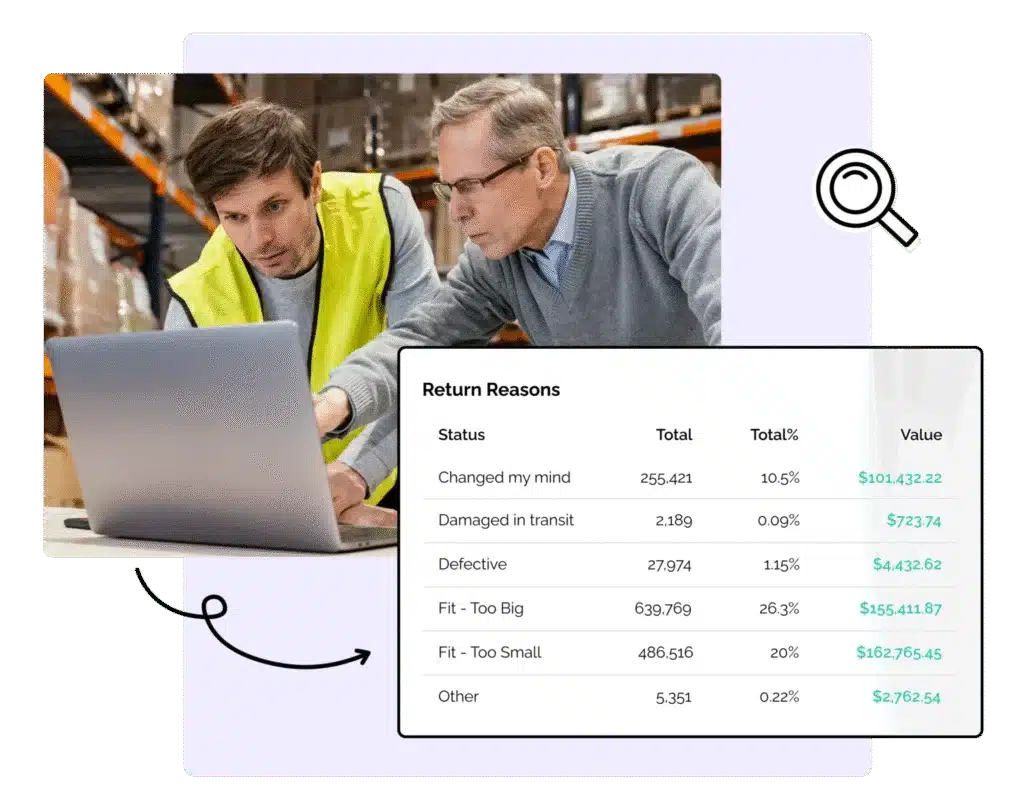
It is important to capture reasons in the initial stages using dropdowns or chatbots, as this will show patterns such as sizing related issues, which will inform product-related changes. This data cycle has averted future returns, and this experience turns knowledge into product development.
2. RMA (Return Merchandise Authorization)
Provide an RMA number and prepaid labels and visual tracker portal. This simplifies approvals, minimizes conflicts, and provides customers with transparency, which decreases support tickets by 2030.
3. Return shipment
There are alternatives: local returns are available to achieve speed in developed markets such as the US, overseas warehouses to consolidated EU delivery, or China-based to be cost effective on worldwide DTC. Select by volume – China is the best with large volumes of reverse logistics.
4. Receiving & inspection
On delivery, scan and sort: resellable (80% target), refurbish (e.g. small scuffs), or scrap (broken beyond repair). Stringent inspection in this case ensures that the infected inventory is not recycled into sales.
5. Repackaging / relabeling
Cleaning, new boxing, and relabeling must be performed according to SOPs to be of original quality. This recovers value- converting 6070 percent of returns into resale inventory, writing offs kept to a minimum.
6. Refund or replacement
Process refunds was inside 48 hrs. to keep CX; spike complaint delays. Provide replacement to loyal customers and create a goodwill and decrease net losses.
Common Reasons for Ecommerce Returns
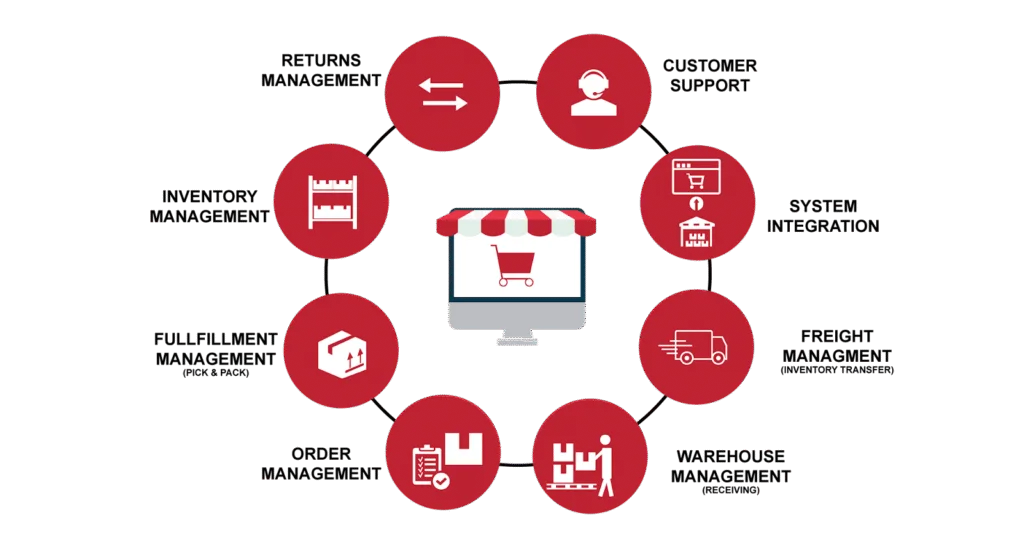
1. Wrong item received
This expensive error comes as a result of picking errors; implement double-scan QC to reduce the drop rates by 5-10 percent and save on reverse shipping.
2. Damaged during shipping
20% of returns are due to poor packaging such as poor cushioning of fragiles. Reduce this by half using drop-tested designs for Ecommerce Fulfillment
3. Product not as described
Return of 1525 percent is attributed to mismatch due to vague listing. Increase precision in 360 photos and specs, which meets expectations.
4. Size or fit issues (especially apparel)
Ordinary in fashion (up to 40% returns), alleviate with comprehensive size charts, user feedbacks, and UGC fit videos – decrease fit errors by 1520%.
5. Quality concerns
Poor quality materials of unregulated suppliers promote suspicion. Improve visibility on the supply chain through pre-shipment audits, limiting quality-driven returns.
Step-by-Step: How to Optimize Your Returns Management
1. Create a clear and customer-friendly return policy
Make it easy: 30 days to refund, no restocking costs on flaws, and schedules as copy: ‘refund within 3-5 days after inspection.’ This fosters confidence, which is stimulated to make purchases, but limits.
2. Use a centralized returns system (RMA automation)
Add features such as Returnly or your own APIs to automatically create RMAs, keep on top of them, and identify trends – relieving the DTC returns workflow of staff and error-proofing it.
3. Improve packaging to reduce damage-related returns
Reinforced materials should be used to handle items of high risk and the size should be economy to prevent volumetric surcharges. Simulation tests to reduce breakage by 25 per cent, which actively assists reduce return rate.
4. Implement strict pre-shipment quality control
Requirement outbound QC: visual inspection, weight checks, and barcodes. This intercepts 90 per cent of wrong item problems prior to shipping.
5. Collect return reason data and track patterns
Register all returns in analytics dashboards, which are segmented by SKU/channel. Identify spot trends such as seasonal sizing spikes and modify sourcing or listings.
6. Efficient return receiving process
Train the staff in fast sorting: refurb area, refurb line, scrap. Well defined SOPs guarantee 24-48 hour response, lowering holding expenses.
7. Improve resale recovery rate
Repackage in efficient relabeling stations; collaborate with imperfects partner second market such as eBay. Goal recovery- 70 percent to cover returns processing costs.
China-Based Fulfillment & Returns: Key Advantages
1. Lower labor & processing cost
Handling and inspection cost $1– 3 per unit compared to 5-10 in the US, which opens up growth margins.
2. Ability to refurbish or repair in China
Close access to manufacturers enables cost efficient repairs such as re-stitching clothing, which cannot be economically matched by the Western warehouses.
3. High flexibility for kitting / repackaging
China operations are able to complete the custom bundling process without adding an extra 20-30% in the packaging cost of the multiple-SKU brands.
4. Better handling for multi-SKU brands
State-of-the-art WMS systems handle a variety of inventories eliminating misplacement that occur in the disjointed systems.
5. Returns consolidation options
Move all global returns to a single hub to batch process, reducing per-unit reverse logistics by 1525%.
Hidden Costs of Returns Most Brands Overlook
It is not about the refunds but about the more serious drains.
1. Reverse logistics cost
Returning to ship can double the outbound costs; reduce this 2030.
2. Repackaging materials
Additional boxes/labels cost $122 per item; bulk sourcing compensates.
3. Damaged items with no salvage
Write-offs occur at 1020% returns; superior upstream protection prevents.
4. Customer support time cost
The duration of each inquiry is 10-15 minutes, and automation releases agents to sales.
5. Inventory confusion / misplacement
Stock lost is holding $5-10k every month; RFID is the solution.
6. Processing delays → Lost sales
Held inventory implies that a stockout occurs; fast cycles are recovered 15 times quicker.
Real-World Case Studies
Case 1 — Apparel brand reducing return rate from 32% → 18%
Issue: Large sizing disproportions eliminated margins. Action: Refreshed size guides that have UGC video and fit calculator, unboxing friendly packaging. Findings: Return decreased by 14 percent, and 50k was saved each quarter on processing, CX scores improved by 25 percent.
Case 2 — Beauty brand improving repackaging & resale recovery
Issue: Minor damages- low 20% resale. Action: Cooperation with china based returns processing to do on site refurbishing and kitting. Findings: The recovery was 65% and they recovered 30k every month in value thereby increasing profits.
Case 3 — TikTok gadget brand reducing “wrong item sent” errors
Issue: 8% wrong shipments were due to viral spikes. Action: Applied the integration of double-scan QC and RMA. Outcomes: The rate of errors reduced to 1% and cutting returns decreased by 7 percent and enhanced customer experience returns through quicker resolutions.
Best Practices to Reduce Returns & Improve CX
1. Strengthen product detail pages (reduce “not as described” returns)
Get the right expectations on high-res images, videos, UGC, and specs – reduce the number of drops by 10 to 15.
2. Offer flexible return options
Add 45 days of swaps easily and improve trust without spiking volumes.
3. Improve product packaging & protection
Fragile inserts are custom-fitted, which is 20% less breakage, which is a direct improvement in CX.
4. Provide proactive customer support
Chat services on the query of fits eliminate 15 percent of possible returns.
5. Use analytics to understand return drivers
Differentiate by SKU/country/channel/season; optimize weak areas such as seasonal clothes.
6. Maintain clean inventory & SKU data
Picks are checked frequently through audits and so there are minimal problems as far as wrong item is concerned.
How to Choose the Right Returns Management Partner
1. Ability to handle reconditioning & repackaging
Find refurb options in-house to get the most out of it.
2. Multi-market return addresses
International alternatives such as the US/EU/China hubs to route effectively..
3. Real-time RMA tracking
Visibility dashboards, minimizing customer enquiries.
4. Low-cost labor for inspection
China-based, because it is cheap but not high quality.
5. Integration with Shopify / Amazon / TikTok
Uninterrupted APIs of multichannel how to manage ecommerce returns.
6. SLA for return processing speed
48 hour turnarounds guaranteed to defend CX.
Conclusion: Returns Are a Hidden Growth Lever
Dividends are not a cost center but rather an optimization center. Effective management results in increased repurchases, reduced losses and constant profits. Optimizing the returns management nowadays, ecommerce brands will be able to safeguard the profit margins, enhance customer experience and generate long-term customer loyalty.