When small ecommerce brands are going through the first growth phases, the decision on whether to do 3PL or in-house fulfillment can either be the difference between success and failure- between the day to day processes and the long-term sustainability. This choice has a direct impact on profit margins due to cost-reduction in logistics, the delivery speeds that are up to the increasing customer expectations and the overall satisfaction which leads to repeat business and reviews. Fundamentally, in-house fulfillment provides direct control flexibility, but requires huge initial investments in operational warehouses and human resources whereas 3PL fulfillment provides scalable, outsourced services with pay as you drive flexibility, and in many cases, it incorporates more sophisticated systems, such as WMS (Warehouse Management System) to ensure the accuracy of inventory. The vast majority of small ecommerce companies grow quicker and with lower costs when they enlist the services of a 3PL fulfillment, particularly when the volume of orders grows past the startup years.
The Core Differences Between 3PL and In-House Fulfillment
What is In-House Fulfillment?
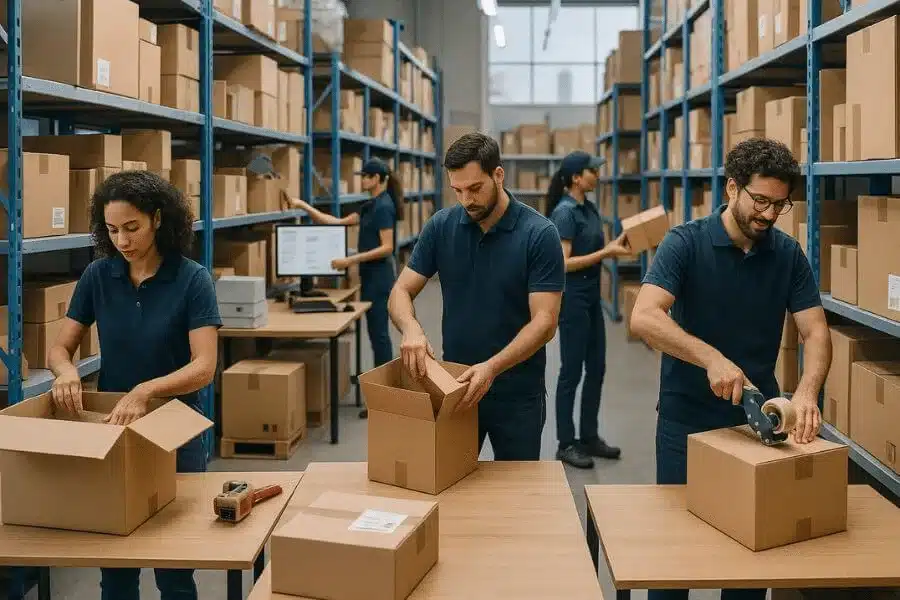
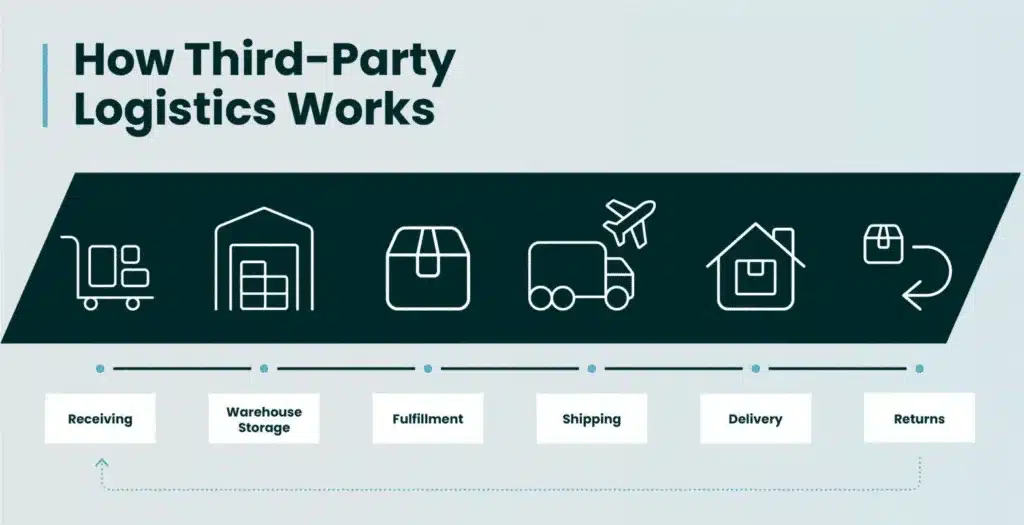
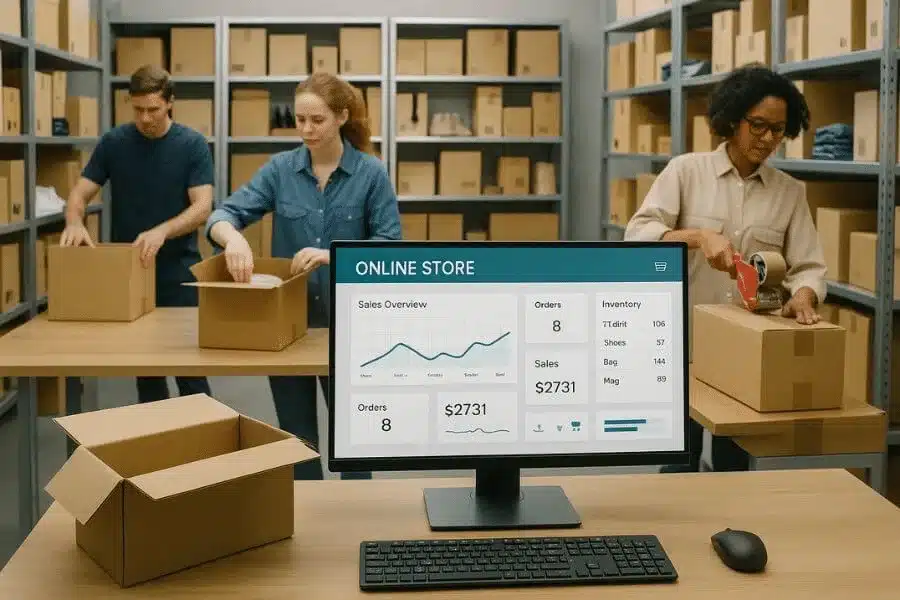
In-house fulfillment implies in-house execution of the whole process of receiving inventory and picking, packaging, and shipment of orders to the destination, usually in a rented facility or even garage by bootstrapped sellers. This is usually during the initial stages when orders are minimal that is below 15 a day and founders have the time to monitor every minute detail and can make adjustments as it goes. Nonetheless, with increasing brands, this model reveals the weaknesses such as unpredictable operations in the warehouses when there are spikes in demand.
What is 3PL Fulfillment?
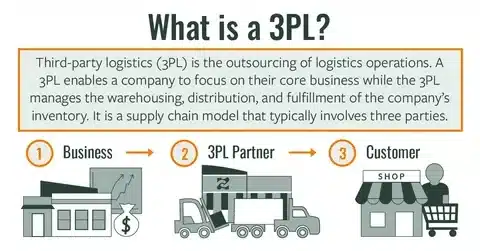
In-house fulfillment implies in-house execution of the whole process of receiving inventory and picking, packaging, and shipment of orders to the destination, usually in a rented facility or even garage by bootstrapped sellers. This is usually during the initial stages when orders are minimal that is below 15 a day and founders have the time to monitor every minute detail and can make adjustments as it goes. Nonetheless, with increasing brands, this model reveals the weaknesses such as unpredictable operations in the warehouses when there are spikes in demand.
Key Differences in Cost, Systems, Labor, and Scalability
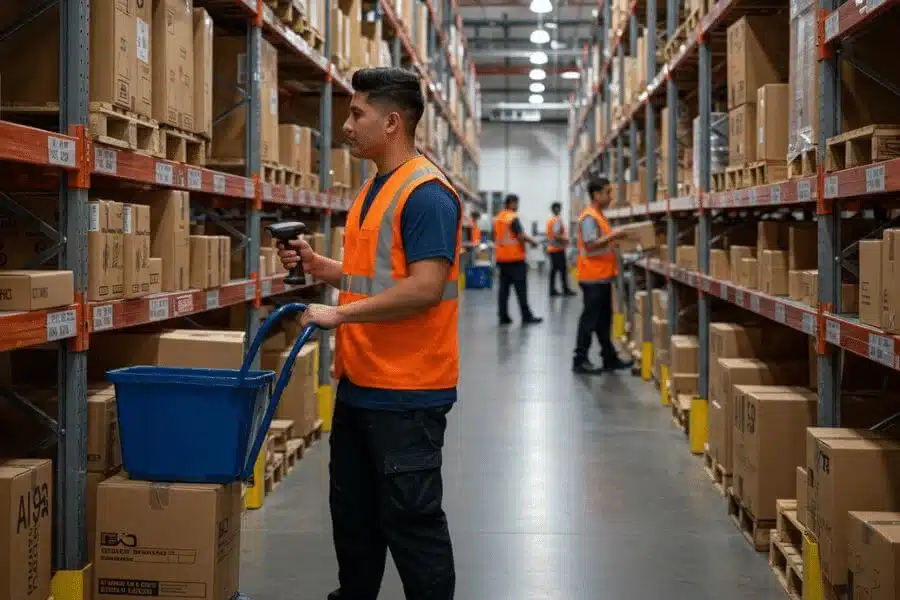
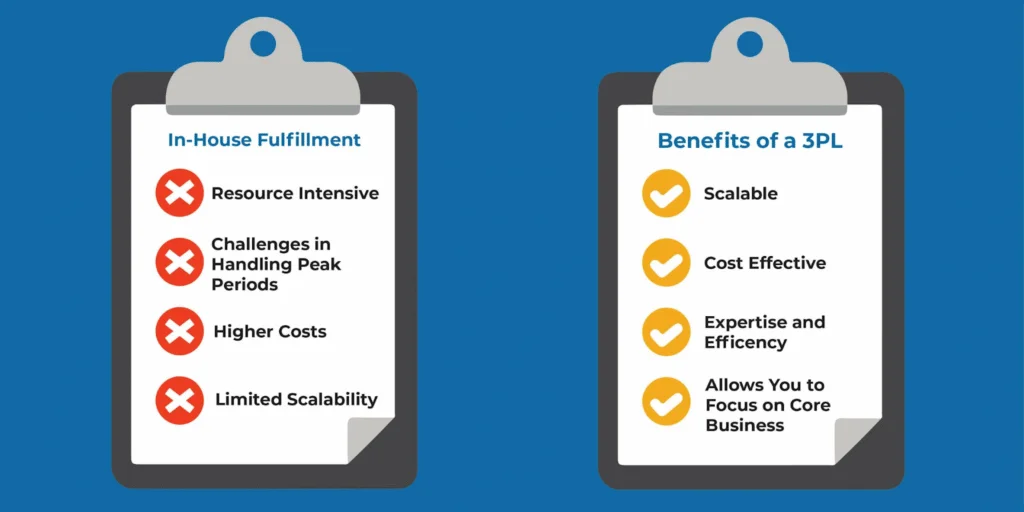
Prices vary tremendously: In-house is with fixed costs such as rent and utilities, whereas 3PL is variable and pay-as-you-go models that increase with volume. Regarding systems, 3PLs use efficient WMS visibility on inventory and minimize mistakes characteristic of manual in-house systems. Another area of weakness is labor, as recruiting and employee training consumes time internally, but the 3PLs offer trained workforces that do not present the turnover issues. Where 3PL excels is scalability, which can be expanded very quickly without any capital investment as opposed to in-house that is bound by physical premises.
Why Fulfillment Strategy Matters More for Small Sellers
Fulfillment is not only logistics but it is also a survival tool to the small sellers. Bad decisions result in pain points such as shipment delays increasing the rate of returns or excessive inventory tying up cash. A cunning approach, such as 3PL vs in-house fulfillment assessment, will make sure that resources are spent on growth, not operations, which will stick out in the markets with high competition directly.
Advantages of 3PL Fulfillment for Small Ecommerce Brands
Lower Overhead and Reduced Operational Workload
Switching to 3PL eliminates fixed expenses, there is no need to rent a warehouse nor to maintain equipment, and it allows capital to be used in marketing. With small brands, it can be a relief of packing boxes and founders can revert to strategic action.
Faster Scalability Without Hiring or Warehouse Expansion
3PL allows scalable order fulfillment by taking on order spikes, such as the holiday peaks, without the need to hire additional personnel or space. This flexibility is accommodating in allowing the small businesses to compete with the larger businesses, which can easily expand to new markets.
Access to Professional Packing, Storage, and Shipping Workflows
In 3PL, professional workflow implies the fragile products are better managed, storage is optimized to avoid damage, and shipping is efficient and reduces transit time. This increases the operations in the warehouse way above the capacity of the majority of small teams.
Lower Logistics Cost Through Optimized Carrier Rates
The bargain of 3PLs with the carriers results into negotiated bulk rates, which are the cause of cost reduction in logistics, which is usually 20-30% of shipping costs on small volumes. This is enhanced by China 3PL which ensures placing warehouses close to suppliers which reduces cross border costs.
API Automation Reduces Manual Errors
The API integrations automate movement of order through third-party service companies such as Shopify fulfillment or Amazon seller fulfillment, enhancing inventory accuracy and reducing the number of errors that cause expensive refunds.
Improved Customer Experience via Faster, More Reliable Delivery
With SLAs increasing processing speed, predictable last-mile contentment, lower returns, and better satisfaction is important, as most tiny brands work on loyalty acquisition.
Case-Style Example: A Small Brand Moving From In-House → 3PL
An example is Take Bellabeat, a brand that focuses on wellness: In-house delays and high returns were a problem, which is why they shifted to a 3PL, reducing fulfillment times and increasing the volume of orders without the need to pay extra. They saw a decline in their return rate and their growth became faster as operations became smoother.
Advantages of In-House Fulfillment (When It Works)
More Direct Control Over Packing and Handling
In-house brings about tactile control whereby bespoke touches such as branded inserts are to fit well in your vision- it would be ideal when every detail counts.
Good for Low Order Volume (<15 Orders/Day)
On a small scale, in-house makes it easy and low-cost without having to pay minimum fees that certain 3PLs will impose on low-volume customers.
Useful for Highly Customized or Fragile Products
In the case products require special assembly or extreme attention, in-house would avoid failure in communication that may arise with outsourced teams.
May Feel “Simpler” During Early Startup Stage
The low barrier required in in-house (no contracts, just your space and time) makes bootstrappers more inclined to in-house.
The Hidden Costs of In-House Fulfillment
Warehouse Rent and Storage Expansion Costs
The rent increases with the increase in inventory and expansions raise capital requirements- burdens that small sellers ignore till the bills stack up.
Labor Cost + Training + Turnover
Employment of packers implies constant wages, time, and risks of turnover, which diverts focus to the business.
Inventory Mismanagement Risks (Overstock, Stockouts)
In the absence of WMS, manual tracking will result in overstock consuming cash or stockouts forfeiting sales- trap holes of expanding brands.
Slower Order Processing During Peak Seasons
Hills overwhelm the small-scale groups leading to stalling of returns, damaging ratings and inflating individual in-house fulfillment difficulties.
Time Taken Away From Marketing, Sales, and Product Development
The founders that put the boxes together will not be able to be innovative; this opportunity cost will leave the growth deader than the actual costs.
Why Small Brands Often Underestimate These Costs
The assumption of in-house being free with the use of our home space is seen but once scaled we can realize that it has a real impact on our time and scalability.
Cost Comparison: 3PL vs In-House Fulfillment
Cost Structure of In-House Fulfillment (Labor / Rent / Equipment / Utilities)
Internal racks increase fixed costs: $1,000-15/month recurrent rent, $15/hour labor, equipment such as shelves, utilities- in-house- will cost 450 orders/month 4,000/5,000.
Cost Structure of 3PL Fulfillment (Pay-As-You-Go, Storage, Pick-Pack)
Variable price of 3PL: pick-pack is charged at $2-5 per order, storage costs are charged at 0.50/ sq ft, and shipping is usually neutralized as volume increases.
Why 3PL Becomes Cheaper as Order Volume Grows
Economies of scale work in favor of 3PL at larger volumes, which lowers the unit costs when there is ballooning of in-house fixed costs.
How Upstream Fulfillment in China Lowers Total Landed Cost
China 3PL reduces hops in the transport, decreases landed costs, 15-25% proximity to suppliers and consolidated shipping.
Scenario Example: 10 Orders/Day vs 100 Orders/Day
In-house can cost 1,500/month at 10/day, at 100/day, it increases to 10,000 with expansions but at 3PL, it remains in the range of 5,000-7,000 which shows the benefit of 3PL in terms of cost.
Which Option Is Right for a Small Ecommerce Brand?
Choose 3PL If Your Brand Wants to Scale Faster
In the case of growth-centric brands, 3PL has a scalability to deal with bursts without infrastructure headaches.
Choose 3PL If You Sell on Shopify / Amazon / Multi-Channel
Shopify fulfillment or Amazon seller fulfillment is hassle-free with the multi-platform sellers enjoying seamlessly integrated systems.
Choose In-House If Fully Customized Packaging Is Required
In-house is strict in case of non-negotiable custom requirements.
Choose In-House If Extremely Low Order Volume
Below 10-15 orders/day, in-house eliminates 3PL minima.
Hybrid Model: Start In-House → Transition to 3PL When Ready
Start in-house, change to 50 orders/day growth limit, etc.
How to Transition From In-House to 3PL Smoothly
Prepare SKU Data and Inventory Forecasting
SKUs Audit SKUs and predict demand to prevent handover stockouts.
Centralize Supply Chain Closer to Suppliers
China 3PL has been used to achieve upstream efficiency which minimizes delays.
Migrate Orders Gradually (Test Period)
Begin with 20 percent of orders in a test of 30 days to kill kinks.
Ensure API Integrations and WMS Syncing
Install APIs to have real time data and be in control of inventory.
Optimize Packaging Rules & Order Instructions
Give clear guidelines to suit your branding.
Monitor Performance During First 60 Days
Monitor SLAs, returns and costs; readjust accordingly.
Conclusion: 3PL Is the More Scalable Path for Small Ecommerce Brands
Conclusively, 3PL fulfillment works out better through its variable expense, high automation and scalability compared to fixed costs and constraints of in-house fulfillment. Micro ecommerce brands that use 3PL save time, reduce labor and fulfillment expenses, and overcome pain points such as burst orders or elevated return rates in a better way. This route opens up expansion with enhanced cost reduction in logistics, inventory precision, and delivery which is focused to the customer. Personally, having provided advice to cross-border sellers, I have witnessed the way 3PL has turned the operations into a drag or driver. When you are reaching the limits of growth, evaluate your volumes and contact a trusted 3PL partner nowadays, it is often the breaking point that can make small brands take steps ahead.