
Total landed cost is not just product price plus shipping — it is the complete cost of getting your product from a Chinese factory to your customer’s hands in the USA.
Total landed cost = Product Cost + Freight + Duty + Customs Fees + Inland Transport + Fulfillment Costs
Many sellers still calculate profit based only on product price and international shipping, ignoring duty, clearance fees, warehouse storage, and order fulfillment expenses. Accurate landed cost calculation is the foundation of sustainable ecommerce profitability.
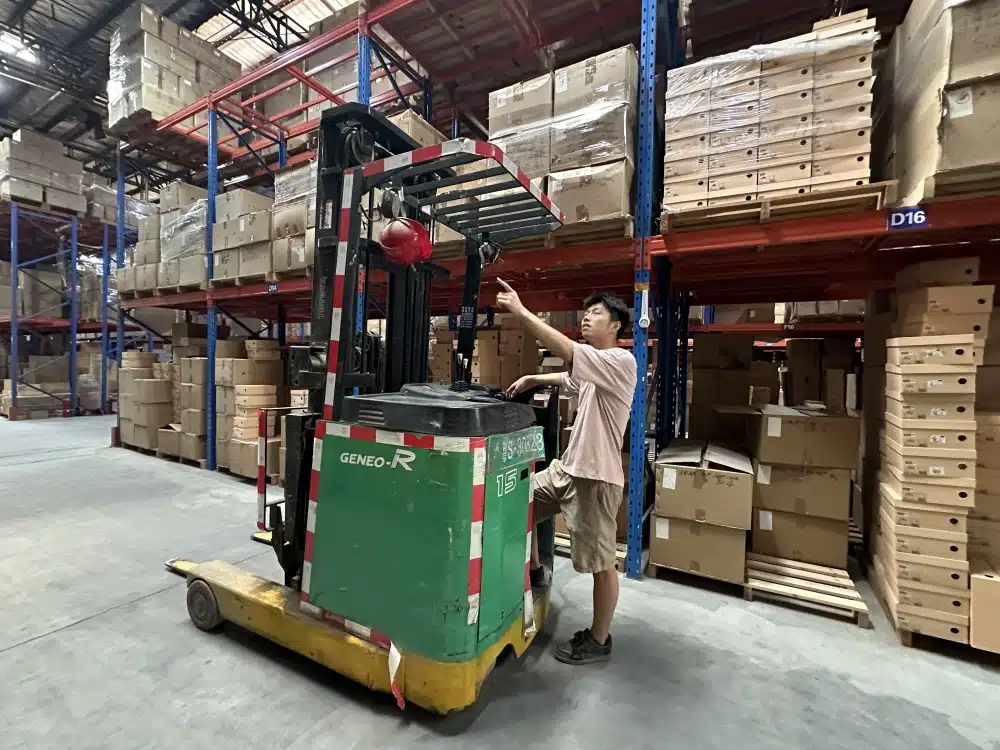
What Is Included in Total Landed Cost?
A clear total landed cost breakdown is the only way to know your real import cost from China to USA. Every expense from the factory gate to the moment the product reaches your customer must be included.
| Cost Component | When It Occurs | Paid To |
| Product Cost | Factory purchase | Supplier |
| International Freight | Export to USA | Freight forwarder |
| Customs Duty | Import clearance | US Customs |
| Customs Brokerage | Entry processing | Broker |
| Inland Transport | Port to warehouse | Trucking company |
| Warehouse Storage | Inventory holding | 3PL |
| Fulfillment Handling | Pick & pack | 3PL |
| Last-Mile Shipping | Final delivery | Carrier |
This import cost from China to USA view prevents the common surprise of discovering your “profitable” product actually loses money once all layers are added.
Step 1: Calculate Product Cost (EXW or FOB)
Your landed cost journey always starts with the right product cost baseline. Choosing the correct Incoterm changes who pays for what and how clean your numbers stay.
FOB vs EXW cost calculation matters more than most sellers realize. Under EXW the buyer handles everything after the factory door. Under FOB the supplier manages export clearance and delivers to the port, which simplifies logistics operations and landed cost modeling for most US importers.
| Term | Supplier Responsibility | Buyer Responsibility |
| EXW | Factory only | Everything else |
| FOB | Export clearance + port delivery | Main freight & beyond |
When you import pricing China USA, always ask your supplier for both EXW and FOB quotes so you can run accurate scenarios.
Step 2: Add International Freight Costs
International freight is usually the second-largest line item after product cost, yet many sellers treat it as a fixed number instead of a variable that changes monthly.
China shipping cost to USA differs dramatically between air and sea. Air freight suits high-value or urgent items but carries dimensional weight charges that can significantly increase your shipping costs. Sea freight offers far lower per-unit impact for volumes above 500 units.
DDP shipping cost from China includes duty and delivery to your door, while DAP stops at the port. Always clarify the term before comparing quotes.
Sample Freight Comparison (1,000-unit shipment, 800 kg total weight)
| Shipment Type | Total Cost | Per Unit Impact |
| Air Freight | $4,200 | $4.20 |
| Sea Freight | $950 | $0.95 |
Factors such as peak season surcharges, fuel adjustments, and West Coast vs East Coast routing can swing these shipping costs 20–40% within weeks.
Step 3: Calculate Import Duty & Customs Fees
US import duty calculation is non-negotiable and often the hidden margin killer. Every product needs a correct HS code classification — get this wrong and you risk audits or overpayments.
Typical calculation example
Product value (CIF): $10,000
Duty rate: 10 %
Duty = $1,000
Add Merchandise Processing Fee (0.3464 % of value, min $27.75, max $538.40) and Harbor Maintenance Fee (0.125 % for sea shipments).
| Item | Formula | Amount |
| Customs Duty | Value × Duty Rate | $1,000 |
| Merchandise Processing Fee | Value × 0.3464 % | $34.64 |
| Harbor Maintenance Fee | Value × 0.125 % | $12.50 |
| Brokerage Fee | Flat or % | $150 |
Customs clearance fees USA also include any Section 301 or anti-dumping duties that may apply to your category.
Step 4: Add Inland Transportation & Warehouse Costs
Once goods clear customs, inland transportation & warehouse costs begin. These are frequently underestimated because they feel “domestic.”
Port-to-warehouse trucking for a standard container from Los Angeles to third-party logistics providers can run $450–$750. Receiving fees, pallet unloading, and put-away charges add another $150–$300 per shipment.
Sample Monthly Allocation (1,000 units)
| Cost Type | Monthly Cost | Per Unit (1,000 units) |
| Inland Trucking | $600 | $0.60 |
| Receiving & Unloading | $250 | $0.25 |
| Storage (first 30 days) | $150 | $0.15 |
Warehouse receiving cost and warehouse storage costs in the USA vary by location, product size, and whether you use stacked or racked storage.
Step 5: Include Fulfillment & Last-Mile Shipping
Fulfillment cost per order turns your landed cost into true customer-delivered cost. Even the best product margin disappears if pick-and-pack plus last-mile shipping eats it away.
Typical breakdown for standard ecommerce fulfillment USA:
| Cost Type | Per Order |
| Pick & Pack | $2.25 |
| Packaging Materials | $0.45 |
| Labeling & Insertion | $0.30 |
| Last-Mile Shipping | $4.50 |
| Total Fulfillment | $7.50 |
When you sell on Amazon FBA or your own Shopify store, these numbers become the final layer that determines whether you actually make money.
Complete Landed Cost Calculation Example
Putting everything together shows how the pieces interact. Here is a realistic 1,000-unit shipment scenario:
| Cost Component | Per Unit |
| Product Cost | $5.00 |
| Freight | $1.20 |
| Duty | $0.50 |
| Inland & Receiving | $0.30 |
| Storage Allocation | $0.40 |
| Fulfillment Handling | $2.00 |
| Shipping to Customer | $4.00 |
| Total Landed Cost | $13.40 |
If your retail price is $24.99, gross margin before advertising and returns equals ($24.99 – $13.40) / $24.99 = 46.4 %. Once you add paid ads (15–25 %), returns (5–8 %), and payment fees, the real net margin shrinks quickly. This is why accurate modeling matters.

Common Mistakes When Calculating Landed Cost
Even experienced importers make these errors:
- Ignoring duty and assuming “shipping covers everything”
- Underestimating dimensional weight on air shipments
- Forgetting monthly storage allocation and potential long-term storage fees when volumes are low
- Not modeling return rate impact on fulfillment costs
- Mixing DDP and FOB assumptions in the same spreadsheet
Any one of these can turn a projected 35 % margin into a 12 % loss.
Why Accurate Landed Cost Protects Profit Margin
Accurate landed cost from China to USA gives you control over three critical areas: pricing strategy, break-even analysis, and strategic fulfillment planning.When you know your true per-unit number, you can set prices that cover all costs plus target profit, decide minimum order quantities that make sense, and allocate marketing budgets without guesswork.
Sellers who track landed cost monthly adjust faster to freight rate spikes, tariff changes, or supplier price increases. Those who don’t eventually face margin compression they cannot explain.
Conclusion — Landed Cost Is a Margin Strategy Tool
Landed cost determines profitability more than almost any other single metric in cross-border ecommerce. It must include every operational component from factory to final delivery. Scale affects allocation — higher volumes spread fixed costs thinner and improve per-unit economics.
Sellers who understand total landed cost from China to USA gain control over pricing strategy, inventory planning, and long-term scalability. Accurate calculation is not optional — it is a competitive advantage.