Various kinds of warehousing services exist that cater to various operational requirements in the current dynamic supply chains. Whether it is the flexibility of shared spaces where startups can be situated or full-controlled facilities in large companies, the appropriate decision can enhance efficiency, minimize expenses, and accelerate the process of fulfilling orders. Selecting the incorrect type, however, can be more costly, suffer a stockout, ship sluggishly, or have restricted scalability.
Most companies believe that every warehouse works in the same manner. As a matter of fact, the various types of warehouses are constructed with particular purpose, inventory patterns and fulfilment plans. These warehousing services are tailor-made to suit different business models – the selection of the appropriate option should be based on the volume of inventory, requirements of fulfillment, and flexibility of operations.

What Are the Main Types of Warehousing Services?
Generally, warehouse services are categorized according to ownership, operating model and purpose. This categorization assists companies in aligning their storage and distribution needs with the most appropriate choice, without the need to spend resources or loss of future growth opportunities.
The importance of the following categories is that each type has its own benefits in terms of cost structure, level of control, scalability and integration with other logistics functions. In brief, here is a summary:
| Warehouse Type | Description | Best For |
| Public Warehouse | Shared storage space rented by multiple businesses | SMEs, seasonal or fluctuating demand |
| Private Warehouse | Owned and operated by a single company | Large enterprises with stable, high-volume needs |
| 3PL Warehouse | Outsourced logistics provider handling storage and fulfillment | eCommerce, dropshipping, and growing brands |
| Distribution Center | Focused on fast-moving inventory and rapid order processing | Retail and high-turnover operations |
| Bonded Warehouse | Goods stored under customs control before duties are paid | Importers and exporters |
The companies considering various forms of warehousing services tend to select 3PL providers to integrate storage, fulfillment and shipping into a single integrated system. It will decrease the necessity to deal with several vendors and enable enhanced visibility throughout the supply chain.
Public Warehousing Services
The public warehousing services provide a dynamic and economical means of storing goods without involving in long term ownership and large fixed expenses.
These common facilities enable various companies to rent space either on a short run or medium term basis and thus they are used when the company is small or medium sized, seasonal seller, or when trying new markets. You only pay the space and services utilized and it helps in saving the working capital and minimizes the risk with regards to finance during low seasons.
The main benefits are the rapid accessibility to storage, low initial investment and easy scaling up or down. Other services that are basic value-added like receiving, picking, and shipping are also offered in many public warehouses. In the case of eCommerce sellers on platforms such as Shopify, Amazon, or Tik Tok Shop this model will accommodate varying amount of orders that do not tie up resources in the form of dedicated infrastructure.
Nevertheless, the ability to control the operations and customization can be less than that of dedicated solutions. Providers may also differ in terms of location and quality of services provided and thus, it is important to carefully vet them.
Private Warehousing Services
In private warehousing, the warehousing service providers convert the storage facility into property and operational ownership of the company.
Within this model, the entire warehouse is owned or rented by a business and all operations are handled, including layout and staffing, inventory systems and security measures. This complete control is especially important in large companies where the inventory that has a high volume is a standard, the quality requirements are strict or the processes are proprietary and require protection.
The key advantages are customized workflow, enhanced integration with internal operations, and the possibility to design storage conditions precisely to the requirements of the products. The increased initial investment in land, building, equipment, and trained personnel is usually justified in the long-run.
Conversely, there are disadvantages of having the warehouses privately owned which depict a huge capital and perpetual running cost. When demand is not constant they are less responsive, and scaling often involves increasing the physical plant, not just by adding rented space.
3PL Warehousing Services
The 3PL warehousing is the process of outsourcing storage, inventory management, and frequently fulfillment to a dedicated third-party logistics vendor.
These vendors integrate warehousing with more extensive logistics skills, such as order handling, packaging, labeling, kitting and shipping. To eCommerce sellers and importers, 3PL warehouses provide scalability without the hassle of constructing or maintaining their own warehouse.
Integration with fulfillment operations is a key strength. Most 3PLs have sophisticated warehouse management systems (WMS), real-time tracking, and easy API integrations with solutions such as Amazon, Shopify, or bespoke ERPs. This structure contributes to one-piece dropshipping, quickness of orders and multi-channel selling.
The other major benefit is scalability, the ability to scale up or down, space and services as your business expands or during seasonal peak. The 3PL partners with experience also possess industry experience that will streamline processes and minimize mistakes in the long run.
Distribution Centers vs Traditional Warehouses
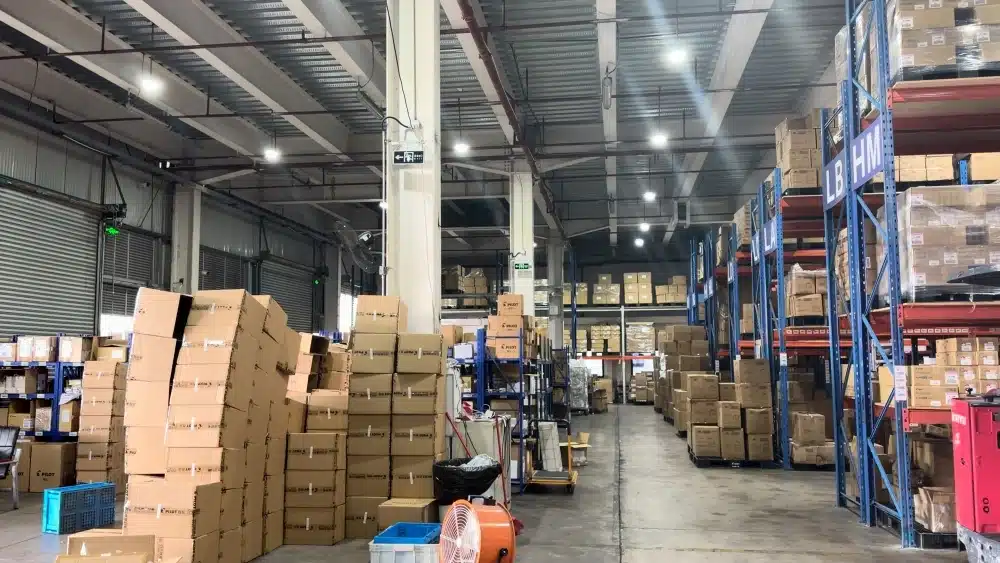
The main difference between distribution centers and traditional warehouses is that distribution centers are more concerned with speed and movement, but not long-term storage.
Although a traditional warehouse has been focused on having inventory in place with high security and at longer times, a distribution center is designed with a focus on fast processing, sorting and outbound shipping. Goods do not last weeks and months but remain hours or days.
On the following one there is a definite comparison:
| Feature | Warehouse | Distribution Center |
| Purpose | Storage and inventory buffering | Fast distribution and order fulfillment |
| Inventory Flow | Slow to moderate turnover | High turnover and quick movement |
| Usage | Long-term storage, bulk holding | High-volume retail, eCommerce, omnichannel |
In the retail and eCommerce settings when customers demand quick delivery, the distribution centers are prevalent. They have cross-docking features, automatic sorting systems, and layouts that are determined to minimize the handling time. Contrarily, traditional warehouses are appropriate to businesses whose inventory is slower moving or seasonal and that they must be stored until they are required.
Specialized Warehousing Services
Niche warehousing services are offered to products that have special storage, handling, or regulatory needs that cannot be safely or legally stored or handled in general warehousing facilities.
Examples include:
- Bonded warehouses – These are facilities, sanctioned by customs authorities that enable imports to be stored without paying duties and taxes until they can be released to be used within the country or re-exported to other countries. They enhance liquidity among foreign traders and help them to meet trade laws.
- Cold storage warehouses -The cold storage type is for temperature sensitive goods like food, pharmaceuticals and some chemicals, and these are kept at a specified climate to retain quality and increase shelf life.
- Storage of hazardous goods — Facilities that are prepared and qualified to store dangerous materials, chemicals or flammable products and in strict compliance with safety and environmental requirements.
A specialized warehouse can guarantee the integrity of the product, adherence to regulations, and minimize the chance of damage or sanctions. A large number of 3PLs currently provide these options in their services.
How to Choose the Right Warehousing Type for Your Business
To choose the right warehousing type, it is necessary to make a clear evaluation of your operations and future growth strategies.
The major factors that determine the key decisions are the size of business, volume of inventory and turnover rate, the frequency of order, the nature of products used, budget limit, and the geographic requirement. Such a mismatch may result in either unnecessary expenses or customer dissatisfaction.
Take into consideration the following practical suggestions:
| Factor | Recommendation |
| Small business | Public warehouse (low commitment, flexible) |
| Growing eCommerce | 3PL warehouse (scalability + fulfillment) |
| Large enterprise | Private warehouse (maximum control) |
| International trade | Bonded warehouse (customs and cash flow benefits) |
Assess your order profiles, peak seasons and integration needs with current systems. The closeness to suppliers or customers can be a major determinant to the cost and time of shipping. Technology compatibility – particularly API access and real-time visibility – is becoming more crucial to contemporary supply chains.
Common Mistakes When Choosing Warehousing Services
Even the most seasoned supply chain experts occasionally commit expensive mistakes in choosing warehousing service. The following are the most common traps to be avoided:
- Picking on the price alone – The lowest prices might not be the best technology, location, or service quality that your business requires, and will cost more in the long-run.
- Overlooking scalability – What works today can be a bottleneck as the order volume increases or product lines broaden.
- Failure to take into account fulfillment needs – Storage does not suffice in most cases, most businesses can do without additional picking, packing, labeling and shipping facilities.
- Ignoring location – bad location with respect to your customers or suppliers will add up to transit and delivery expenses.
By taking time to match the warehousing model with your overall supply chain strategy, you can avoid these problems and can make the operations run more smoothly.
Conclusion — Choosing the Right Warehousing Type Matters
The choice of the appropriate warehousing service type is a strategic choice, which directly influences the efficiency of operations, cost management, and performance in the contemporary supply chain.
Knowing the advantages and disadvantages of public, private, 3PL, distribution, and specialized warehouse profiles, eCommerce sellers, importers, and supply chain managers will be able to create a more robust and flexible network of logistics. Every decision is always the one that fits your unique inventory movement, business model and growth goals, and gives you the ability to devote more of your energy to the core operations, at the same time having a stable and affordable storage and delivery.