Most companies interpret that 3PL and warehousing are one and the same concept when in reality the two are different stages of logistics service. Warehousing and 3PL (third-party logistics) are different in that warehousing is more of a storage facility whereas 3PL is the full-fleet and entire logistics solution of fulfillment, inventory control, and freighting.
Knowing about this difference in the beginning will make eCommerce sellers, sourcing managers, and supply chain teams less stressed. The wrong choice of a model may cause increased expenses, postponements, or a slow growth, particularly in companies managing China imports or platform-selling as in Shopify, Amazon, and the Tik Tok Shop. The correct decision is one that matches storage and fulfillment with your order quantity and product complexity and expansion strategies.
What Is Warehousing?
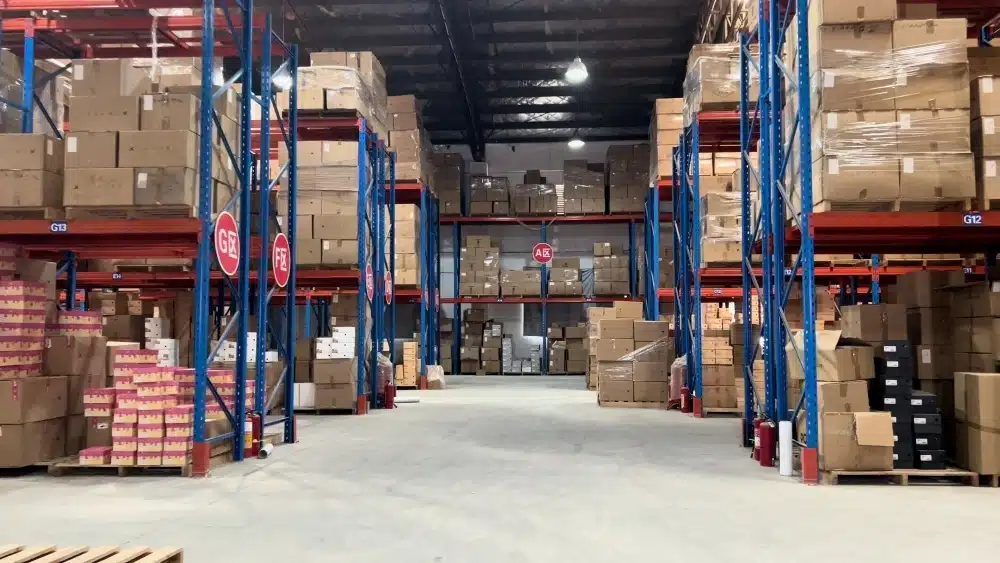
Warehousing can be defined as the physical storage and sorting of products to be stored in a special building. In its purest form, it encompasses the intake of inventory, organizing goods so that they may be easily accessed, monitoring the quantities of stock available and giving a safe storage until the time when the goods are required.
Typical operations that are included within the traditional warehouse services include:
- Raw materials, finished products or components which are long term or short term storage.
- The arrangement of inventory is simple with shelves, racks or stacking up in bulk.
- Simple accepting and delivery without higher order processing.
Considering a variety of small to medium enterprises that have constant but insignificant needs, but still require the security of preserving the product and its availability, warehouse services may be a simple idea of keeping it safe and in reach. Nevertheless, they do not go so far as to work on customer orders, picking, packing, and shipping. This model is effective in situations where your team handles fulfillment either in-house or through basic manual mechanisms.
When businesses consider the logistics models, they tend to compare the alternatives of various 3PL warehousing services with the aim of making the most appropriate choice of operation. Unlike full-service solutions, simple warehousing solutions have the control highly internal to the business owner with minimal external dependency.
What Is 3PL (Third-Party Logistics)?
The definition of 3PL, or third-party logistics, implies the transfer of more extensive logistics services to another provider of logistic services. As compared to a simple storehouse, a 3PL ally takes care of the entire supply chain process to allow enterprises to concentrate on selling, product innovations and customer attraction.
This full 3PL service generally involves:
- Warehousing outsourced along with proactive inventory.
- Order fulfillment – picking, packing and assembling items to be shipped.
- Combination with eCommerce systems to become efficient.
- Shipping management, returns processing and occasionally value added services such as kitting or labeling.
To eCommerce sellers and scaling SMEs, 3PL services provide visualization based on systems through warehouse management software (WMS), real-time tracking, and automated work processes. Such integration eliminates mistakes in the hands of people and also is capable of multi-channel selling without the need to create your infrastructure.
Key Differences Between 3PL and Warehousing
The basic withstanding disparity is capability and range. Warehousing has been making its focus on storage, whereas 3PL provides a widespread logistics service which far goes beyond maintaining goods in one place.
In this way there is a remarkable analogy:
| Aspect | Warehousing | 3PL |
| Function | Storage | Full logistics solution |
| Services | Limited (storage + basic organization) | Comprehensive (fulfillment, shipping, returns) |
| Flexibility | Lower | Higher |
| Integration | Minimal | System-based (API, platform connectivity) |
The third party logistics and warehouse arrangements also vary on their development with regard to growth. Warehousing comes with fixed capacity that you control, but 3PL providers use shared facilities, technology and carrier contacts to be reconfigured in a short time period.
When Should You Choose Warehousing?
Select simple warehousing whereby your operations are relatively simple and predictable. This model is appropriate in businesses that have low levels of order volumes, are normally stable in demand and have low needs in fulfilment.
Typical scenarios include:
- Minimal inventories and low inventories.
- Companies that would rather have full control of their inventory and do their picking/packing.
- Import/Export enterprises or buying departments were primarily concerned with the storage of raw materials or bulk products then they would be produced or sold to another.
- Initial drop shipping businesses, in which storage facilities are secondary to supplier coordination.
In these instances, it ensures that overheads are kept down and the costs incurred in outsourcing fulfillment are eliminated. You have direct control and it may be essential when dealing with highly specialized or sensitive products.
When Should You Choose 3PL?
Use 3PLs when your company has greater order quantities, operates in a variety of sales outlets or requires greater automation and scalability.
This would be reasonable in the case of:
- Increasing eCommerce activity on Shopify, Amazon, or Tik Tok Shop with seasonal surges.
- Companies that are growing fast and require more fulfillment but do not need to invest a lot of funds.
- Businesses that need high inventory control, real-time identity, and speed in delivering products to their customers.
- SMEs wishing to simplify their operations and have access to consultant logistics services.
The use of 3PLs is also effective in dealing with demand spikes and swings, compatibility with existing systems, and additional value added features like custom packing or kitting – features that are usually not accessible in basic warehousing.
Benefits of 3PL vs Warehousing
Both models present their own benefits in accordance with the business priorities. Warehousing is the one that provides cheaper base costs on pure-storage, whereas 3PL performs best in that area of efficiency, scalability and operational support over the long-term.
Consider this overview:
| Benefit | Warehousing | 3PL |
| Cost | Lower base cost | Higher but scalable |
| Efficiency | Limited | High |
| Scalability | Low | High |
| Automation | Minimal | Advanced |
By using 3PL, a company usually enjoys negotiated carrier rates, advanced WMS systems and the adaptability to rent space and labor at will without overall overhead. By contrast, warehousing can be cheaper when the needs are very predictable and that the needs are low complexity and the internal resources available can cope with the demand.

Common Mistakes When Choosing Between 3PL and Warehousing
Most decision-makers falter when there is an assessment of logistics solutions. To prevent such traps, it is good to achieve these long-term results:
- Price is the only factor — selected only on storage charges and not considering the overall cost of fulfillment including labor cost, mistake, and shipping cost.
- Overlooking scalability – choosing a model that is not scalable and your business grows, which results in inability to fulfill capacity requirements that occur in peak seasons.
- Failing to view fulfillment needs – failing to look at whether you do need picking, packing, and multi-channel shipping assistance.
- Underestimating the complexity of their operations – thinking that simple warehousing will be adequate with more order volume or product variety.
These problems are avoided by careful evaluation of existing and future order profiles.
How to Decide: A Simple Framework
On the way to selecting the adequate logistics partner, it is essential to begin with a sincere assessment of your business scenario. Depend on this simple model to make your decision:
| Business Situation | Best Choice |
| Small inventory | Warehousing |
| Growing eCommerce | 3PL |
| High order volume | 3PL |
| Basic storage needs | Warehousing |
Other considerations when doing this are product type, level of different sales channels, rates of returns, and your bandwidth as a team. Businesses that have low-volume operations with stable business and internally strong processes tend to lean towards warehousing. The companies that undergo a high growth rate or multi-platform selling tend to take advantage of 3PL services flexibility better.
Conclusion — Choose Based on Operational Needs
The decision on which is better between 3PL and warehousing lies in the end in your business model and needs of fulfillment and growth. Being aware of the differences will enable firms to choose the appropriate long-term efficient logistics solution and not to fail to the lowest costs or the one they understand most.
Appearance is better than the price. An effective model will lessen the bottlenecks, boost accuracy of the orders and free up the resources that can be used in activities that are of essence such as the sourcing of the products and marketing. Before making any decision, take the time to sketch your present order volume, a projected growth trend, and pain points of your operations. The aim is a logistics structure that facilitates sustainable scaling and not its impediment.