Introduction
Suppose this: you have found a potential product that consumers would like to see in the market, and you stand at the crossroads. Would you buy your products in the big pool of manufacturers on Alibaba and sell them on Amazon? Or are you able to spare the bother of going into the specifics of international sourcing simply because you are handling the marketplace of Amazon? It is one of those dilemmas that thousands of e-commerce business owners experience on a day-to-day basis, and your choice could be the key that helps or hinders success in your business venture.
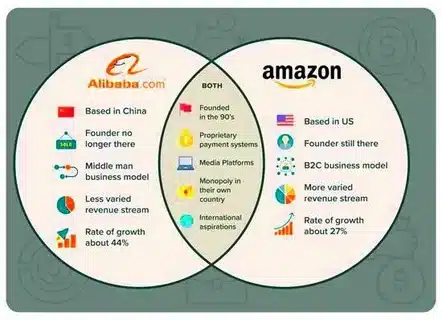
Throughout this all-inclusive tutorial on online selling , you will learn the key elements and distinctions of both of these e-commerce giants, when to exploit each platform, and how to strategically use both to get the most out of them in terms of profits. As the global supply chains transform, the rules of cross-border trade alter, and consumer demands grow in the world , it has never been more important to understand how to navigate between both Alibaba and Amazon to ensure e-commerce success in the ever-changing market landscape of 2025 and further on.
What Are Alibaba & Amazon? Basic Definitions and Business Models
Alibaba is a business-to-business (B2B) kind of a market that connects the producers and suppliers with the retailers, wholesalers, and entrepreneurs interested in ordering product in bulk and provide trade assurance. Alibaba was established in 1999 as an online company that connects the manufacturers in China and foreign buyers and offers all goods, beginning with raw materials up to finished goods, and can be customized, label their own goods, and a system of favorable wholesale prices.

Amazon, on the other hand, is a Business-to-Consumer (B2C) marketplace where individual sellers and brands are able to engage in direct sales in direct contact with end consumers and list merchandise in a direct way. In addition to its marketplace service, Amazon is a full-service fulfilment company with Fulfillment by Amazon (FBA) that offers fulfilment services to sellers, provides customer support, return management, and marketing solutions to enable sellers to reach its millions of active customers globally.
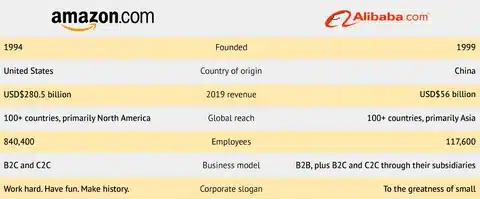
The basic difference in their target audiences and models of transactions includes how each handles payments. Alibaba enables large-volume deals among companies, which usually include minimum order quantities and lead time, whereas Amazon allows the sales of single products with immediate shipping and delivery to the customer. The sellers of Alibaba are manufacturers or suppliers, and the sellers of Amazon may be any individual entrepreneur or a large corporation that sells directly to consumers.
Core Differences in Key Areas
Sourcing & Manufacturing
Alibaba also does a great job of connecting buyers with thousands of trusted manufacturers who offer a wide range of customization options, trade guarantees, their own labels, and low prices on large orders. Sellers can now talk to manufacturers about the features, packaging, and branding of their products. This lets them make unique products that meet some market demand and may help them make more money. But it needs a lot of supplier audits and quality control steps, and in most cases, it needs a minimum order of 50 to 10,000 units, depending on the product being sourced. Amazon also uses its sourcing strategy when it buys things from current distributors, retail arbitrage, or products that are already branded. Even though Amazon doesn’t make things, it helps sellers find out what is selling, analyze their competitors, and find new places to sell things by giving them access to a huge customer base and search tools.
Fulfillment & Logistics
The FBA service offered by Amazon includes storage, packaging, shipping, and customer service after goods arrive on Amazon warehouses, which gives their sellers access to Prime shipping and Amazon trusted fulfillment network. This provides smooth customer and seller experience whereby the time of delivery is predictable and returns and customer inquiries are addressed professionally.
With Alibaba, sellers have to handle international cargo, a customs clearance, import taxes, and logistics themselves, acting as their own middleman . The typical lead times are 15-45 days based on the complexity of the product and modes of transportation and they need meticulous planning on inventory and management of cash. This, however, also gives a greater level of control over shipping expenses and delivery procedures.
Fees, Costs & Pricing Structures
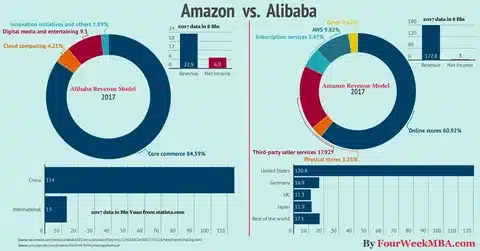
The fees that Amazon collects are referral fees (8-15% depending on the category), monthly subscription fees, FBA fulfillment fees, storage fees, and other fees (advertising and promotion). These charges can be quick to accrue and the sellers should enjoy healthy profit margins to remain competitive at the same time paying all the costs associated with the platform so as to maximize their revenue.
Cost structure of eCommerce Alibaba consists of the product cost, shipping cost, importation cost, examination cost of goods, various fees and the potential sample cost related to the sourcing process. Even though the costs of platforms charges are not incurred on an ongoing basis, it is important that sellers factor in the cost of customs clearance, warehousing and logistics management when ascertaining the total landed costs.
Risk Factors & Quality Assurance
The use of Alibaba sourcing is associated with the risk of such elements as reliability problems in the supplier, inconsistent quality, language, and the possibility of intellectual property exploitation. These risks can be mitigated by conducting due diligence, verifying suppliers, sample testing, and having clear quality specifications that are needed to invest in achieving successful Alibaba sourcing to continue operations safely.
Amazon is a more regulated place with set policies, conflict resolution mechanisms, and security of the consumer. Sellers, however, are at risk regarding account suspension, policy fluctuations, heightened competition, and reliance on the Amazon algorithm and subscription services to gain visibility.
Scalability & Market Reach
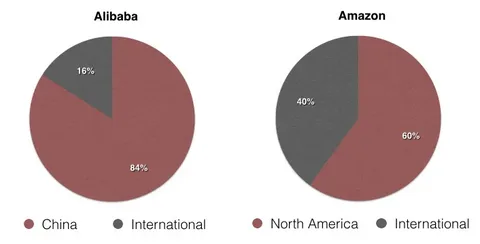
Amazon has hundreds of millions of active customers in various countries, giving it unparalleled chance to reach the market and scale. Effective products have the potential of achieving large volumes of sales in a short period when using Amazon recommendation systems and advertising platforms.
Alibaba facilitates the element of scalability by optimizing costs and customizing products where the sellers are able to create unique products at competitive prices. This method involves establishing a separate brand awareness and customer acquisition strategy, but has higher provisional control of the operations of the business in the long run.
Pros & Cons: When Each Platform Makes More Sense
Alibaba itself is preferable when you require producing special products, require a high degree of customization, require developing low-cost positions through direct contact with manufacturers, or require producing a more distinct brand. However, the disadvantages of Alibaba include a large minimum order quantity, extended lead time, intricacies in quality management, and several start-up expenses before the advantages are achieved. The communication barriers and cultural differences require a great deal of time and experience to work through and plan logistics to scale up the operation.

Amazon is the superior option in case you have quick access to the market and need a simple product testing method, but also favor simpler fulfillment options, or are unfamiliar with the international sourcing process. The platform offers immediate credibility, developed customer trust and full support system to new sellers.
The weaknesses of Amazon are a high level of competition, sustained fee model which may reduce profit margins, reliance on platforms policies and lack of control of relations with customers. Constant investment in advertisement and optimization can be the key to success in order to remain visible.
How to Use Both Platforms Together for Maximum Profit
The most successful business owners of e-commerce can be found operating both sites in a tactical way to get new customers: discovering special products in Alibaba and selling them online with the assistance of Amazon and its gigantic amount of customers. By applying such a strategy, Alibaba could work on exploiting its cost-based advantages and customization options with Amazon, its market penetration, and fulfillment network.
It begins with product research done based on the information that Amazon has to determine profitable opportunities, and then finds appropriate suppliers on the Alibaba platform to create products that meet specific market needs. After negotiating good terms, quality inspection is performed, and international shipping is accomplished.
Goods are delivered to Amazon FBA warehouses and instantly appear on the market, professional pictures and descriptions are created, and specific pricing schemes are taken into account, taking into consideration all costs and charges, and the marketing strategy brings traffic and conversion and makes a profit.
Case Studies and Real Examples
Take the example of a seller who discovered a gap in the kitchen gadget market after doing some research with Amazon, and found a manufacturer in Alibaba to create a distinctive product with a special package and branding. Ordering 1,000 units and increasing gradually to 10,000 units after every quarter allowed them to realize 50,000 monthly revenue after 18 months with 35 percent profit margins.
The other business partner had a problem with the quality of their initial supplier on Alibaba which lead to poor reviews on Amazon and the temporary suspension of sales. They made it through strict quality control measures, collaboration with inspection services and establishment of relationships with numerous backup suppliers which finally led to more stable operations and better customer satisfaction.
Best Practices and Tips for Sellers
The key to choosing the right suppliers is to ask for and test a few samples, make sure the business has the right licenses and certifications, make video calls to see how well they communicate, and have third parties check the quality before placing large orders. To start a long-term relationship that is good for both sides, you need to build good relationships by talking to each other often, setting up good payment terms, and making sure that the business maintenance is of good quality to keep customers’ trust and the balance of accounts. To properly manage shipping and customs, you need to know the rules for importing goods, hire a reliable freight forwarder, give an accurate description of the product’s value, and keep accurate records on mobile devices so that customs can clear the goods quickly and avoid delays.
Trends to Watch in 2025 and Beyond
Global trade processes continue to evolve in the framework of differentiating tariff systems, supply chain diversification and focusing on sustainability and ethical sourcing activities. These tendencies infuse the pricing of goods, the criterion of supplier selection, and consumer and demand buying decisions based on the new advertising and delivery service possibilities and challenges are emerging and compelling to sellers.
To actively update the strategy, it is essential to stay informed on news, changes to the policies and updates on the platform to gain competitive advantages over the first movers and to be better positioned in order to reach their target customers. New technologies like artificial intelligence to research products, blockchain to provide visibility on the supply chain, and automated logistics systems are reshaping how businesses source products and serve customers and this creates competitive advantages with first movers and enables them to better connect with their target customers.
Conclusion
Amazon and Alibaba are used complementary to each other in the modern e-commerce ecosystem, where Alibaba offers access to affordable production and customization opportunities, and Amazon offers an unmatched reach to the market and fulfills opportunities. The most effective strategy is usually to have both platforms working together in a tailored, strategically designed fashion, where unique products are procured in the Alibaba manufacturers network and sold and shipped using the Amazon customer base and logistical network to expand market reach. It takes a bit of awareness of the strengths and weaknesses of each platform, having the right risk management measures, and constantly adjusting to the changing market environment and policies of the platform.
FAQ Section
What is the minimum order quantity (MOQ) of Alibaba? MOQs are product and supplier specific and they often range between 50 and 10000 units with many suppliers prepared to negotiate smaller quantities on first time customers or during initial phases of testing.
Is it possible to dropship Alibaba to Amazon? Direct offloads of Alibaba to the Amazonians breach the regulations of Amazon. Goods should be shipped to Amazon FBA warehouse, or the seller has to satisfy orders with their stocks.
What is the workings of customs and import duties? The customs levies follow the classification of goods, country of origin, and country of destination policies, which often vary between 0-25 percent of the value of the product, and other custom processing charges and taxes are imposed in most nations.
What are the Amazon policies on private label brands? Amazon is promoting the idea of selling private labels by offering Brand Registry, which gives registrants of trademarks increased control over their listing, advertising options, and intellectual property protection opportunities buy products.
What to do with returns and customer service, sourcing overseas? Amazon FBA also provides returns and customer services automatically, and merchant-fulfilled orders should provide clear return policies rank higher, quality control systems, and effective customer communication systems.