
It is common for the cost of shipping to vary according to the volume of the shipment; however, manually calculating CBM is not only time-consuming but also prone to error. It is necessary to be able to calculate the cbm for seven cubic meters (CBM) of space that is equivalent to weight in order to arrive at an accurate freight price. This is true regardless of whether you are shipping a single pallet or an entire load of containers. This last source will demonstrate how to calculate CBMs, explain why it is essential to convert volumes into weights when shipping by sea, and illustrate how great dimensional planning may help you save a significant amount of money by simplifying your shipping expenditures and making them easier to comprehend. In the event that businesses are aware of these factors, they will be able to reduce their shipping costs, make more effective use of containers, and make more informed decisions regarding international shipping.
Understanding CBM: The Foundation of Sea Freight Pricing
To find out how much room your cargo takes up in cubic meters (CBM), multiply the length and width of the height in meters. This scale is used to set prices for marine freight all around the world. With air freight, weight is the main thing that matters. With sea freight, though, carriers charge based on either real weight or volumetric weight, whichever makes the shipping line more money.
The concept of charged weight helps carriers make the most money per container without going over their weight and space limits. When moving goods, this transportation cost should be taken into account because it has a direct effect on the price formulation.
Why CBM Calculations Matter in International Shipping
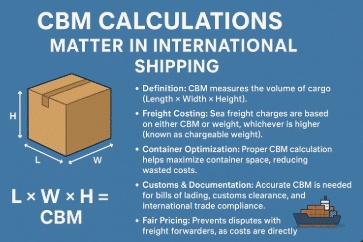
Less than Container Load (LCL) shipments: You need to know about CBM when you use Less than Container Load since you are sharing container space with other shippers. It has a set fee for each cubic meter of space, and reliable calculations make sure there are no bad shocks or arguments with freight forwarders. maximum Container Load (FCL) planning also has the benefits of accurate CBM calculations that will make sure that containers are used to their maximum potential and that there are no empty spaces that will cost additional money on a unit shipping basis.
CBM data also helps in planning warehouses, managing inventory, and making the supply chain work better. Companies who have mastered volumetric computing have a huge edge over their competitors when it comes to costs and operations.
Standard Container Types and Their CBM Capacity
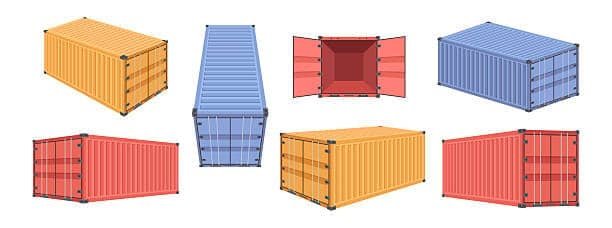
20-Foot General Purpose Containers
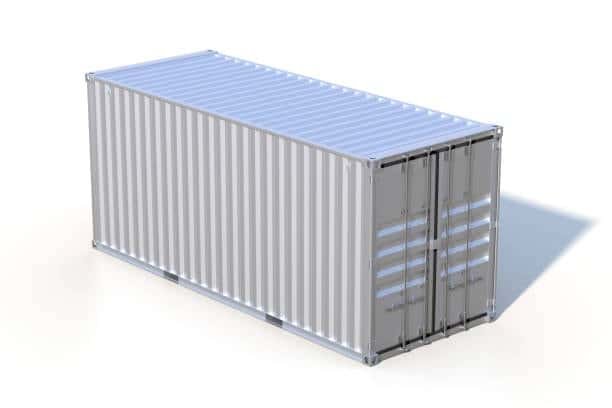
The 20’GP container can hold around 33 CBM of merchandise and has inside dimensions of about 5.9m x 2.35m x 2.39m. These containers can be used when the gross weight isn’t too great and the volume capacity of the container meets the weight capacity. Some examples are machinery, metal goods, and raw materials that have a weight-to-volume ratio that is closer to real weight pricing.
40-Foot General Purpose Containers
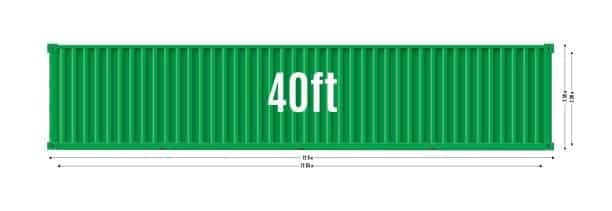
The internal dimensions of the 40GP containers are about 12.03m x 2.35m x 2.39m, and they can hold about 67 CBM. These are cost-effective for medium-density cargo and mixed shipments where weight and volume are equally important.
40-Foot High Cube Containers
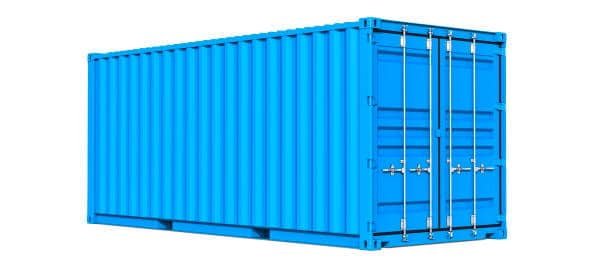
The 40HC has the most space, with a capacity of about 76 CBM and an extra height of 2.69 m inside. These containers are great for both light and heavy cargo when the volumetric weight is used to figure out the shipping costs. High cube containers are usually used for things like textiles, furniture, and consumer electronics.
CBM Calculation Formula and Process
Basic CBM Formula
The simple formula of the basic computation of CBM is as follows: CBM = Length (m) x Width (m) x Height (m) x Quantity.
Measurement of the results should be in meters to get the right results. Measures of centimeters or millimeters divided by 100 or 1000 are meters.
Measuring Package Dimensions Accurately
You need to pay attention to the packing material, how the goods are stacked, and how they need to be covered in order to get the measurements right. You should constantly measure the outer dimensions whether you use any form of protective wrapping, corner guards, or pallet overhang. When you calculate out how much freight to send, a tiny mistake in measurement might make a large impact in the pricing or weight of containers.
Converting CBM to Volumetric Weight
Standard Conversion Rates
The volumetric weight of sea freight is calculated using a standard conversion rate of 1 CBM =167 kg. This conversion ratio also relies on the shipping mode on 1 CBM = 167 kg, the average 1 CBM = 167 kg in the air freight, 1:167 ratio in the sea freight due to a number of operational factors and price models.
Determining Chargeable Weight
Chargeable weight is the weight that has a maximum value of actual weight or volumetric weight. This kind of dual-weight system makes sure that carriers are paid fairly no matter how dense the cargo is:
- High density goods: the actual weight is smaller than the volumetric weight.
- Low-density cargo: the volumetric weight exceeds the real weight.
- Equalized cargo: The weights are more or less the same.
Practical CBM Calculation Example
Scenario: Electronics Shipment
and suppose the delivery of 25 cartons of consumer electronics, 0.8m x 0.5m x 0.4m in size and weight 12 kg each:
Volume Calculation:
- Per box CBM: 0.8 x 0.5 x 0.4 = 0.16 CBM
- Total CBM: 0.16 x 25 = 4.0 CBM
- Volumetric Weight: 4.0 x 167 = 668 kg (1cbm=167kg)
Weight Comparison:
- Actual Weight: 12 kg x 25 = 300 kg
- Volumetric Weight: 668 kg
- Charging weight: 668 kg (it is considerably higher)
This case study shows why it’s common for light and heavy electronics to be charged by freight volume instead of weight. This has a direct effect on shipping costs and the price of LCL ocean freight.
Advanced CBM Optimization Strategies
Mixed Cargo Planning
When a container includes both high-density and low-density contents, it is the best way to send things internationally since it uses the most weight and space. Cargo consolidation is the name of this method. It keeps transportation costs low per unit and makes containers as useful as possible, no matter how many things are in them.
Packaging Optimization
Even slight adjustments to the size of a shipping container may save a lot of CBM when there are a lot of them with the same volume. Think about making your own packing, using vacuum packaging for things that can be compressed, or the new protective substance that keeps things safe and takes up less space.
CBM Impact on Freight Cost Allocation
LCL Pricing Structures
LCL shipping costs are calculated in dollars per CBM, with 1 CBM being the least expensive. These costs and overall volume levels might help you figure out the appropriate amount of shipment and consolidation. Most forwarders have break points at 3 CBM, 5 CBM, and 10 CBM. This means that the price per unit goes lower as you approach closer to the maximum capacity of the container freight class.
FCL Cost Distribution
CBM calculations are used to split up FCL shipments so that each product or SKU gets its fair share of the container cost. The allocation technique is an extra step in finding the proper price and profit for items. This is especially true for businesses who import a lot of various kinds of products in one container that is cm wide and cm high.
Supply Chain Applications Beyond Basic Calculations
Warehouse Space Planning
CBM data is helpful for figuring out how much space a warehouse needs and how much it will cost. The correct volume and total weight calculations will help with better planning of the facility, estimating the cost of storage, and managing inventory schemes with the most cargo weight. This information is helpful when the company’s inventory changes with the seasons or when the number of products is growing.
Supplier Negotiation Leverage
When we know what CBM means, we have an advantage when we talk to suppliers about packaging, consolidation options, shipping terms, and how they affect the freight rate. When it comes to total landed cost, suppliers whose packaging is most like that of sea transport are cheaper than those whose only goal is to keep their products safe.
Inventory Investment Optimization
CBM calculation affects the decision to invest in inventory because it shows how much it costs to ship low-density CBM products. Companies can keep a good balance between their inventories and their storage and shipping costs by using accurate CBM measurements in this kind of analysis. especially when it comes to seasonal or promotional goods, where time and cost-effectiveness are important for both domestic and international shipping.
Common CBM Calculation Mistakes to Avoid
Measurement Precision Errors
If you round dimensions too soon or use different measurement units, you will make mistakes that will add up and make your cost and container loading plans less accurate. Make sure you always get the right calculations and unit conversions for dimensional weight.
Ignoring Stacking Limitations
Some cargo doesn’t use the whole height of the container because it’s too heavy, too fragile, or can’t be stacked. The following factors are used to figure out the usable CBM capacity so that the ocean freight rate isn’t too high.
Overlooking Dunnage and Blocking
Bracing, blocking, and protective materials take up a lot of space in containers, but they are important for keeping cargo safe. When CBM makes its plans and decides how much space it needs, it needs to think about these needs. The cost is based on the length cm x width.
Conclusion
If you can change CBM into kilograms, you will have an edge over other businesses. You can save a lot of money (15–30%) by keeping a close eye on container control and carrier selection cargo weights. This will help you get the most out of your freight budgeting and strategic cargo planning. This will also turn freight into a cost center. If a company knows how much of its cargo is chargeable weight, whether it’s for LCL consolidation coordination or the efficiency of the FCL, they can negotiate lower rates, design their packaging materials better, and make a choice that will directly affect their profitability across their network of supply chain partners.