Introduction: The Hidden Costs of an EXW Deal
Consider this, you have just signed an Ex Works (EXW) transaction with a supplier, where the buyer assumes the responsibility for the logistics . The price is very appealing and then you are confronted with some questions that you had not expected. Who organizes the forklift to pack the goods? Who handles export permits? What would be the case in case of delay in shipment at the customs or damaged during loading? These are not hypothetical issues seller’s premises, they are real situations that trap the unprepared buyers daily.
The knowledge of EXW is not merely in possessing knowledge of a term of shipping, it is in avoiding expensive lawsuits, avoiding some covert expenditure, and ensuring that your supply chain operates efficiently. Most companies have been using EXW without fully understanding what it entails to only to realize that they have undertaken much more responsibility and risk than they had thought, which the buyer bears entirely . A good understanding of the terms of Ex Works can be what takes a good deal and turns it into a logistical nightmare that costs you your margins.
What Does EXW Stand For? Definition and Legal Framework
Ex Works is the acronym of EXW, and it is one of eleven internationally accepted Incoterms 11 Incoterms of the International Chamber of Commerce (ICC). These trade standard terms stipulate trade responsibilities, costs, and risk amid the international and local transactions between buyers and sellers.
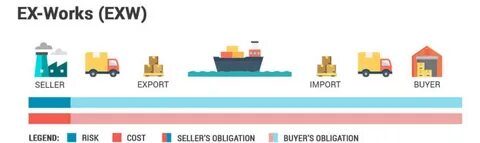
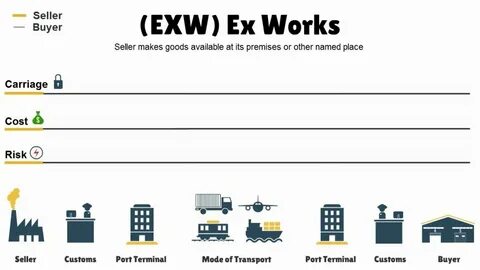
Ex Works is the utmost limit of responsibility by the sellers. The main responsibility of the seller under this term is merely to supply goods at a given location; normally his factory, warehouse or place of business. No need to pack the goods into the vehicle of the buyer, carry out export records, and take care of the goods once they are ready to be collected.
Under the Incoterms, EXW is the most burdensome of all to the buyer, especially when dealing with a destination country . It is the beginning of the Incoterms continuum, in which the duties of the seller are minimal and the duties of the buyer are wide-ranging. This is what makes it very different to such terms as DDP (Delivered Duty Paid) where the seller stretches almost to the limit.
Seller’s Obligations Under Ex Works
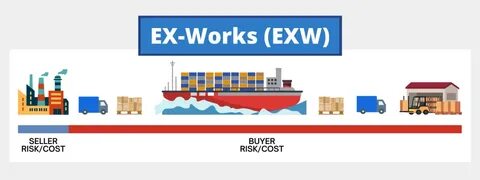
The obligations of the seller in relation to EXW are minimal. Their major responsibility is to ensure that the goods are well packed and to be collected at the agreed place on the agreed date. This is a place that is commonly referred to as the factory of the seller, or warehouse, or any other place where the goods are produced or kept.
More importantly, the seller is not required to load the goods onto the vehicle of the buyer. Although they should make the goods accessible and available, the physical loading process such as furnishing equipment such as forklifts is not a part of normal EXW requirements. The seller too is not responsible towards export clearance procedures (even in case the goods are in the country). They merely have to furnish them with the required paperwork which could be required by the buyer in terms of exportation.
As soon as the goods are availed at the mentioned location, the risk and responsibility of the seller come to an end. They do not bear any liability in case of damages, loss, or extra-charge incurred during loading, transportation or during clearing of the custom.
Buyer’s Responsibilities Under Ex Works
EXW terms put a total responsibility on the buyer, beginning with the availability of goods. They need to organize and meet all the shipping costs and transportation costs between the premises of the seller and the end point whether it is a short distance or a long and intricate one.
It is totally the duty of the buyer to load the goods. This entails the supply of the right equipment, labor, and handling material. In case a forklift is required, the buyer has to make it. In case of special packaging on transportation, it is also the responsibility of the buyer.
The other important buyer requirement is export formalities. The buyer will be required to do all export papers, acquire the relevant import documentation, licenses or permits, and clear the customs in the country of the seller. This may be especially difficult where the buyer does not have the local presence or know how to deal with the local jurisdiction of the seller.
The buyer as well takes the risks that are incurred at the collection point. The buyer is liable to any damage, loss or delays that might arise during loading, transporting or customs. Also, obtaining proper insurance cover is all up to the buyer at his or her own cost.
When and Why Businesses Use EXW
EXW is effective at certain circumstances where the buyers possess good logistics and locality. Firms that have existing agents or offices in the country of the seller tend to favor EXW as they are able to utilize their own logistics system, negotiate on the freight rates, and have full control of the supply chain.
First of all, simplicity is an advantage to the sellers. Their responsibility is minimal, they have less administration and can manufacture instead of logistics. In the case of buyers that have complex supply chains that operate their supply chains, EXW gives control to them- they are able to select their own preferred carriers, routes, and time and do not rely on the arrangements made by the seller.
Nevertheless, EXW has serious disadvantages. Buyers who do not know the local market of the seller might have difficulties in export procedures, language and business regulations. The term puts significant risk on the buyer who is forced to take care of all possible loading accidents up to custom delay. In global transactions, EXW may cause problems in situations where buyers do not have the legal capacity or local expertise to coordinate effectively the export clearance.
Real-World Challenges with EXW Transactions
ExW deals in practice are frequently subject to complications that are not reflected in theory. Export licenses and customs laws may be a major challenge particularly where the buyers do not have local knowledge. The exporter of record must be a local company in many countries, and it is legally complex or even impossible to have foreign purchasers dealing directly with export clearance.
Loading disputes are common. A Philippine supplier can be a small plant with no loading docks or equipment. Upon the arrival of the truck of the buyer, there are questions: Who supplies the forklift? What in the event that during loading in the hands of the buyer, goods are damaged? These situations cause tension and liability claims.
Another aspect of complexity is the inspection requirements. In case any customs or quality inspection is required prior to export, who handles this? With strict EXW, this is addressed by the buyer, and it may be cumbersome and time-consuming to organize inspections in a different plant both the buyer.
Take the case in point, a foreign customer orders one of the small manufacturers in Manila to supply him with machinery on EXW. The buyer will need to contract a local agent to deal with export paperwork, transportation out of the factory, supply loading gear, and maneuver Philippine customs- all over the internet. Any slack or problem at the factory gate is the problem and cost of the buyer.
Comparing EXW with Other Incoterms
To have a clear picture of EXW, it is necessary to compare it with other terms. FCA (Free Carrier) usually is a preferable option to international trade since the seller does the export clearance and loads at a common location negating most of the EXW complexities without still providing the buyer with the control of main carriage buyer’s risk.
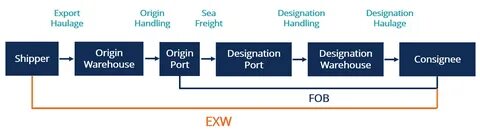
FOB (Free On Board) is used in terms of a sea freight where the seller is involved in loading goods to the ship and takes care of the export formalities. This puts greater responsibility on the seller than EXW, including potential loading charges, and is more realistic when using the ocean deliveries.
At the other extreme are DDAP (Delivered At Place) and DDP (Delivered Duty Paid). In DAP, the seller arranges goods to a designated location and bares all transport risks. DDP extends to include import clearance and duties with the seller also handling the import duties.
EXW should not be used in international transactions where the buyer does not have a presence in the country or in cases where the export laws demand local players to clear the goods. It also becomes problematic when buyers do not get access to the physical location of the seller to make arrangements to load and when it is hard to get insurance cover once the collection location export process.
Other parties bargain altered conditions such as EXW loaded whereby the seller consents to load a product although technically the term is not the standard one. Although this covers the practical aspects there is ambiguity and this should be clearly written in the sales contract domestic market.
Best Practices for Negotiating EXW Terms
One needs to negotiate with care and have comprehensive documentation to effect successful EXW transactions. Ensure that you name the precise place of location with a full address – not only the factory of the seller but the actual location of the facility including including building number, name of street, city, and the postal code.
Determine accurate preparedness schedules and pick-up intervals. Specify the timing of the delivery and the amount of time that the buyer has to have to organize the collecting. This helps avoid quarrels over time wastage and both sides are able to organize the logistics effectively.
Discuss the loading question in your contract. Although standard EXW does not presuppose that the seller loads goods, it is the buyer’s responsibility to ensure that setting standards avoids misunderstanding. In case the seller has accepted to help in loading, record this as a contract amendment with clear conditions regarding equipment, liability and expenses final destination.
The factor of insurance is decisive. Buyers are supposed to cover a lot beginning at the premises of sellers. Never think that goods are safe during loading or initial transportation, make sure that your policy covers every step of loading onwards.
Hire the services of trained freight forwarders or three-party logistics companies (3PLs) who know the local requirements and can take care of export business on your behalf. An efficient 3PL will be able to run through the customs, organize the proper transportation, and manage the paperwork, making your risk and workload much smaller.
Watch for hidden costs. The good EXW price you have bargained does not cover loading equipment’s, export documents cost, custom broker, domestic transportation, and warehouse costs in the event of late collection, leaving you with full risk buyer’s designated method. Include all the landed cost within the budget and not only the EXW purchase price.
Clearing Up Common EXW Misconceptions
The international trade has a number of misconceptions about Ex Works. The most prevalent is the assumption that the sellers have to load the goods onto the transport of the buyer. With conventional EXW terms, this is not true, as all that the seller has to do is to make goods available. The fully on loading is upon the buyer unless it is explicitly agreed.
The other misunderstanding is that of agents. Other consumers make the assumption that, when they provide an agent to get goods, there is a way that such an agent can be able to persuade the seller to load. This isn’t accurate. The agent will be working on behalf of the buyer and will be required to load himself except there is an agreement with the seller.
Responsibility with export clearance tends to bring conflicts. In EXW, buyer takes care of all the export formalities though they are selling goods of the country where the seller is. This may pose practical challenges hence the reason why most of the specialists suggest FCA as an alternative in global deliveries.
The question many people ask is whether EXW can ever be appropriate to international trade. The response is: yes, it can but under certain conditions. EXW is effective when the buyers have strong local presence, are aware of local regulations and are able to handle export processes effectively. In the majority of international operations, however, such terms as FCA or FOB are more convenient and cause fewer difficulties.
Conclusion
The simplest and the seller-friendly Incoterm is Ex Works where maximum responsibility and risk are left on the buyer since the time goods are available at the premises of the seller. Whereas EXW is simple to the sellers and controlled to complex buyers who have local logistics, the mode poses a serious difficulty to those who are unacquainted with the market of the seller, as well as those who lack the resources to handle the exporting operation, loading, and transportation between the point of departure and the destination. EXW is most suitable when the buyer has local agents and well-developed logistics infrastructures in the country or when the buyer is a domestic. In the majority of international trades, where the purchasers are not present in the home country of the seller, options such as FCA, FOB, or DAP allocate liabilities in a more realistic manner and alleviate the burden of the expensive litigation or other regulatory issues. The selection of your Incoterms should be based on your knowledge of your logistics, risk tolerance and knowledge of the local market because sometimes the cheapest EXW price is not the most effective when it comes to overall costs and risk.