

Introduction
Canada to the United States (USA) shipping is one of the most important cross-border trade routes in North America, where billions of dollars of money are exchanged each year. Regardless of whether you are operating an e-commerce company and have to expand southward, ship personal objects to your relatives, or use logistics in the B2B scenario, the complexity of Canada-US shipping can turn into the key to profit and loss, happy and unhappy clients.

This complete manual will prepare you with all the issues required to overcome international shipping and cross-border shipping. You will learn the influence of different factors on cost and delivery time, different shipping methods and their trade-offs, and gain some practical experience into what to optimize in your shipping strategy. On a grand scale, the cost to ship your products differs based on speed needs, size of your package, and carrier options by a huge margin, and other miscellaneous expenses such as brokerage fees and fuel charges can severely affect your bottom line unless you have adequately prepared against them.
Key Factors that Determine Cost & Delivery Time
Package Weight & Dimensions
The shipment cost on the majority of shipping options is determined by weight; however, dimensional weight pricing has become more significant. Carriers determine dimensional weight by multiplying length, width height (in inches) by a dimensional factor (normally 139 domestic, 166 international). You will pay either the actual weight or the dimensional weight, whichever is greater. This implies that a big light package may cost as much to deliver as a small heavy package cheapest way.

Origin & Destination Location
The distance is a very important factor, though not only in miles. Major metropolitan areas such as Toronto to New York have more affordable and quicker solutions because of pre-existing shipping routes and greater amounts of packages. Destinations in the countryside usually have extra charges and require more time of transport time. This is also a factor of border closeness; the movement of goods between Windsor, Ontario, to Detroit, Michigan will be cheaper and shorter than shipping goods between Vancouver and Miami.
Speed & Service Level
Express shipping services are capable of delivering packages in the span of 1-3 business days but at 3-5 times the cost of ground options. The ground shipping normally takes 2-8 business days based on distance. Economy wants can also be completed within 1-3 weeks, but the advantages are higher for shipments that are not urgent. The trick lies in aligning the level of service to the real business requirements instead of having to fall back to premiums.
Customs, Duties & Taxes
Shipments between countries are subjected to customs, and it may take 1-3 days to complete. The responsibility and taxation are based on the nature, value, and source of the product. In the US, most goods have a minimum de minimis of 800 dollars; thus, goods which have low value do not pay duties. Nevertheless, all shipments have shipping documents and customs declaration forms, and mistakes may lead to serious delays.

Packaging & Insurance
Professional packaging is not only a protective measure of the goods; it can also help save the dimensional weight expenses due to the reasonable utilization of the space. The rates of shipping insurance are widely 1-3 percent of the declared value, but it provides large coverage of valuable property. Tracking services are optional occasionally, but they have become significant to customer service and problem-solving.
Carrier Reliability & Tracking Features
Carriers are various, and each one is good in its own way. There are those with better tracking technology, others with better customer service, and those that specialize in niche industries or types of packages. Although some routes are less reliable than others, major routes tend to have a higher degree of reliability than those in isolated locations.
Common Shipping Methods & Their Comparison
Postal Services
Canada Post, in collaboration with USPS, provides the cheapest alternative for small packages. Regular parcel service normally requires 4-7 business days and is the cheapest shipping alternative as compared to courier services. With moderately increasing prices, Expedited Parcel shortens this to 2-3 days. But there is a lack of tracking, and there is a size restriction (maximum 30 kg/66 lbs).
Express Couriers
UPS, FedEx, and DHL are the best services to offer premium services with good tracking, quicker transit time, and full insurance. The UPS Standard is generally delivered with a tracking number in 1-3 business days, whereas UPS Expedited offers next-day delivery to large cities in the United States. A middle ground is FedEx International Economy, which has a time of delivery of 2-3 days at competitive rates. These services involve customs brokerage, but on most occasions, they charge extra fees for this service.
Ground/Truck Freight
Less-than-truckload (LTL) freight is economical when it comes to transporting shipments of more than 70 pounds. The time of transit is 1-5 business days, based on the distance and schedules of carriers. This approach is effective with business-to-business deliveries but involves the use of commercial addresses to pick up and deliver.
Air Freight
Air freight is the fastest (usually next-day) and most expensive mode of cargo transportation reserved for urgent, high-value, or specialized cargo. It is best when the goods are business and have a time constraint for shipments or goods of a special nature.
Sea Freight
Sea freight via the Great Lakes and coastal routes may be very cost-effective in case of a very large or less urgent shipment. Transit times, however, can go up to weeks, whereas this approach is mainly feasible inthe case of bulk commercial shipments.
Real-World Examples & Rate Comparisons
Take a package of 5 pounds, 12 inches x 8 inches x 6 inches, which is loaded in Toronto but which is to be shipped to Chicago:
Canada Post Regular Parcel: $35-45 CAD, 4-7 business days, basic tracking UPS Standard: $65-75 CAD, 2-3 business days, full-service tracking and insurance DHL Express: $85-95 CAD, 1-2 business days, full-service tracking and insurance.
A shipment of 50 pounds (24″ x 18 x 12) of business (Vancouver to Los Angeles):
Canada Post Expedited Parcel: $125-150 CAD 3-4 business days UPS Standard: $180-220 CAD 2-3 business days LTL Freight: $95-120 CAD 3-5 business days (commercial addresses only)
These are used to demonstrate the scaling of the costs based on weight, as well as the service levels based on the costs. Express services are highly priced, whereas postal services are most suitable in terms of the cheapest rates in case of small, non-urgent packages.
How to Save Money When Shipping
Compare Multiple Carriers & Get Quotes
Always insist on the best quote. Check the online calculators used by major carriers and not only compare base rates but also actual costs delivered, taking into consideration fees. Carriers with similar network strengths and pricing strategies tend to set drastically different prices on the same shipment based on their strengths.
Leverage Shipping Calculators & Rate Shopping
Shipping calculators of the modern world give real-time prices and delivery times. Note, however, that advertised rates might not be inclusive of every fee. In making a comparison, the factors in shipping labels, fuel surcharges, brokerage fees, and possible duty costs.
Consolidate Packages & Volume Shipping
When sending several products in a single package, it is practically cheaper than individual shipments. In the case of businesses, volume discounts can be opened by opening an account with carriers. Through shipping volumes, the small businesses can negotiate better rates when the volumes are at regular levels.
Choose Appropriate Service Levels
Equip shipping velocity to reality. A lot of businesses fail to deliver on the services that could be delivered through ground shipping. In the case of B2B shipment, an additional day (or two) hardly merits twice the shipping fee.
Pack Efficiently to Avoid Surcharges
Optimize dimensional weight charges by right-sizing the packaging. Apply the right cushioning supplies that are protective and not overly bulky. When developing a product, think of the impact of the packaging design on the shipping cost.
Ensure Proper Documentation
Proper customs statements save on delays and other charges. Take time to know how to classify the products properly and keep well-documented records. Malfunction in documentation may lead to costly delays and re-routing fees.
Customs, Duties, Taxes & Regulations
Understanding De Minimis Thresholds
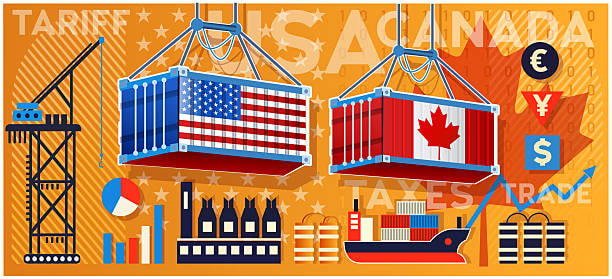
Most goods in the United States have a de minimis threshold of $800; i.e., shipments whose value is less than this threshold usually do not pay any duties and do not go through formal customs entry procedures. Nevertheless, even the low-value shipments still need the customs declarations. The Canadian duty and tax threshold for imported goods in the US is 20 CAD and 40 CAD, respectively.
Required Documentation
Commercial shipments must be accompanied by elaborate commercial invoices giving details of the description of products, values, quantities, and country of origin. Individual deliveries require a custom declaration form using a proper description and value. The items are prohibited from being undervalued as a way of evading taxes, which may lead to fines, delays, and further inspections.
Restricted & Prohibited Items
The two nations have long lists of prohibited and restricted goods that must be documented on a commercial invoice. Typical contrabands are some foods, plants, firearms, and explosives. Even such things as seemingly innocent wooden products can demand special permits or treatments. Conduct extensive preliminary research to eliminate the chance of expensive returns or seizure.
USMCA Trade Agreement Benefits
USMCA offers preferential treatment to qualifying goods. Goods that conform to the requirements of the origin can be subject to lower or no duties. These benefits cannot be claimed without proper certification and documentation.
Delivery Duty Paid vs. Delivery Duty Unpaid
By selecting DDP (Delivery Duty paid), the shipper does all the work of clearing through customs and also pays all the duties and taxes, which means that the recipient knows the exact cost involved. DDU (Delivery Duty Unpaid), why not until customs open and pay out fee to recipients, this may lead to the delay of delivery in case recipients are not ready to immediately pay.
Packaging, Labeling & Insurance Best Practices
Selecting Proper Packaging Materials
Pack in new and strong boxes that suit the weight and fragility of the contents. Corrugated cardboard boxes of the right burst strength are the best in ensuring protection at reasonable costs. Do not use old boxes, which can break in the process of shipping and make insurance useless.
Optimizing Dimensions & Weight
Design packages in such a way that the dimensional weight is kept to the minimal level and sufficient protection is provided. In the case of items that are shipped regularly, custom packaging should be considered to maximize the size-protection ratio. One inch less in the size of the packaging can save a lot of money in shipping costs in the long run.
Clear, Accurate Labeling
Send clear and understandable addresses with post codes and phone numbers. Put back addresses on all deliveries. Customs labels should be correct and descriptive; vague labels such as gift, sample, etc., may create added questioning and waiting.
Insurance & Tracking Considerations
Valuable things should be insured, and purchase records kept. Low-price coverage by carriers includes only a low level of protection, and in case of high-value shipments, it is wise to consider extra insurance. Most services are now tracked, and the tracking has been a lifeline to both the shippers and receivers.
Step-by-Step Shipping Checklist
Pre-Shipping Preparation
The first thing to do is to weigh your package with an accurate weighing machine and measure the package. Get research on any limitations on your particular products in the destination country. Select suitable packing material and prepare all the things you will be required such as customs form, labels, and documents.
At Shipping Time
Choose the right level of service depending on your time and budget. Prepare all necessary documentation properly, as far as the customs declarations are concerned. Choose the terms of delivery (DDP or DDU) depending on relations with the recipient and his/her capability to complete the customs clearance.
Post-Shipping Management
Tracking of monitoring information and taking proactive actions to inform recipients of anticipated delivery times, shipping calculator. Retain shipping receipts and documentation in case of need of insurance claims. Put in place protocols for receiving delivery exceptions or damage claims as soon as possible shipping process.
Potential Pitfalls & How to Avoid Them
Hidden Fees That Impact Total Cost
Advertised shipping rates can be increased by 2050 percent as a result of brokerage fees, fuel surcharges, and remote area surcharges. Also, always demand total delivered cost estimates that cover all the possible fees shipping labels. Other carriers impose considerably lower charges than others for customs brokerage services that are not categorized as base charges cheapest shipping options.
Border & Customs Delays
Most of the customs delays are brought about by incomplete or inaccurate documentation. Make a rightful investment in the classification of goods and ensure information on products is well kept. Additional time to clear customs should be taken during the seasonal periods, such as the Christmas shipping policy. Shipments on Fridays tend to take longer in the customs offices; on weekends, cut shipping costs.
Delivery Terms Confusion
Poor perception of who does duties and how this is conducted presents tension with customers and may lead to shipments being returned. Provide delivery terms in advance and make sure that the recipients know what they are supposed to do concerning DDU terms post office.
Overpaying Due to Poor Planning
The last-minute shipping choices usually lead to a lack of service choice and excessive payment. Pre-plan shipments so that when feasible, they can use ground services. Bigger packaging can create dimensional weight penalties; therefore, it is better to have a smaller package.
Frequently Asked Questions (FAQs)
How can small items shipped in Canada to the US be transported most economically? Canada Post’s Regular Parcel service is usually the cheapest service for 0-30kg packages, particularly when the shipment is not urgent, and offers cheap shipping rates. But compare delivered costs in totality with any possible customs on the cost of shipping companies.
What is the average duration of customs? Common customs clearance normally introduces 1-3 days of business in transit. Shipments with complexities or those that have to be checked may take more time. Weekend delays at the customs facilities are experienced mostly on Friday arrivals shipping from Canada.
Do I need insurance? The items of value, fragile or important shipments, should be covered by insurance. Carrier coverage is usually basic, and therefore, when determining the levels of carrier cover, the reality is the real cost of replacing the items expected delivery date.
Are there items I cannot ship? Yes, the two countries have long lists of prohibited and restricted items. Typical contrabands are some foods, plants, firearms, and explosives. Check restrictions before shipments.
What are the delays that are common during busy seasons? Peak seasons (Christmas, back-to-school) may increase normal transit times by 1-3 days because of the increase in volume. There is a risk of weather (especially during winter), which may lead to further delays. Consider it and set the expectations with recipients.
Conclusion
The only way to make shipping between Canada and the US work is to find a balance between the costs, speed, and reliability, as well as the customs and carrier options. The best way to send packages abroad without spending too much money depends on your needs: When it comes to small, non-urgent packages, Canada Post is a good choice. For time-sensitive items, an express courier will speed up the process and follow it. For large packages, freight will be cheaper.
The key to success is to be well-prepared. The right paperwork will save time in case of expensive delays, the right package will protect against damage and dimensional weight charges, and comparing carriers will make sure you get the best deal at the lowest shipping cost.
By keeping these rules in mind and avoiding mistakes like hidden costs and mistakes in the paperwork, you will be able to come up with a shipping plan that will help you meet your business goals and keep your customers happy. Whether you’re moving your own things or running your own business, you’ll always be glad to take your time and learn what you need to know and how to get ready to spend less and avoid headaches in the future.