
That is because the structure of business in terms of subscription box fulfillment is more complex than the standard ecommerce fulfillment process. On the other hand, on-off orders are concerned with speed and accuracy when making single picks, whereas as a subscription model precision is required through recurrent cycles, multi-SKU assembly, and a constant fluctuation of the subscribers. Kitting mistakes do not only impact a shipment but increase in months, undermining trust and increasing churn. Inventory planning has to take into consideration the churn rates and default actions which makes the seemingly predictable demand look more of a volatility forecasting problem.
Numerous brands believe that the task of subscription fulfillment is just a continuation of the usual DTC functions. The reality is the recurrent cycles and kitting complexity present operational needs that are truly different, and the standard warehouses are unable to cope with it effectively.
The scalability of subscription box fulfillment demands synchronized kitting precision, recurring demand forecasting as well as churn conscious inventory control.

What Makes Subscription Box Fulfillment Different?
The business model of subscription box delivery is non-linear with the norms of ecommerce mainly because it is recurring and requires the capacity to bundle products.
As opposed to individual purchases, subscription boxes require complex multi-SKU fulfillment with curated packages on regular intervals, which produces an extra anticipation of consistency, presentational, and timeliness. The customers perceive every delivery with a customer service as an extension of an existing relationship and therefore any discrepancy such as lateness of delivery, the failure of a product or bad assembly has a direct effect on retention.
| Feature | Standard Ecommerce | Subscription Box |
| Order Type | Single SKU | Multi-SKU bundle |
| Frequency | One-time | Recurring (monthly/quarterly) |
| Forecasting | Reactive (based on sales) | Scheduled with churn adjustments |
| Complexity | Low to medium | High (kitting + cycle management) |
These variations as well compel brands to reconsider merchandising design, worker placements, as well as system integrations at the warehouse. What can be successfully operated with sporadic orders fail under the strains of predictable and variable batch processing.
Kitting: The Operational Core of Subscription Fulfillment
The operative core of the subscription box fulfillment process is kitting, as exact assembly is of direct influence on customer satisfaction rates and returns.
Pre-made packages are available in situation where a stable, high-volume subscription with regular themes are required which make it possible to prepare such subscriptions in opening off-peak. On-demand kitting supports variable sizes or customized items, but needs accuracy of picking on-the-fly and elastic workforce. Monthly themes bring an extra dimension where having a rotation is required to ensure that the themes remain fresh while avoiding excessive inventory commitment.
| Kitting Method | Best For |
| Pre-assembled kits | Predictable volume, standard themes |
| On-demand kitting | Variable subscription size, personalization |
| Themed monthly kits | Curated product rotation, seasonal variety |
The issue of labor planning is imperative here. Assembling requires special areas, inspections at several points and skilled personnel so that there can be the least number of errors- every misfortune would run in to recalls which cost 2 to 5 times more than precautions. During high-volume months, poor kitting capacity results to hurried work, increased defect rate and the ultimate resultant dissatisfaction by the subscribers.
Managing Recurring Order Cycles
Repeat order cycles require a tight timing control to coordinate billing, assembling, and shipping without interfering with cash flow and inventory.
Cut-off dates that are monthly fixed subscriber numbers, which provoke demand validation and SKU assignment. Windows on batch shipping are next with scaled work and carrier coordination to deliver promises of consistency.
| Cycle Stage | Operational Requirement |
| Subscriber billing | Payment processing and renewal confirmation |
| Demand confirmation | Final subscriber count after churn/pauses |
| Order lock date | Freeze changes to prevent mid-cycle errors |
| SKU allocation | Reserve inventory for locked orders |
| Assembly window | Kitting and packing in batch |
| Labor scaling | Temporary staff or overtime for peaks |
| Shipping window | Coordinated carrier pickups |
| Carrier coordination | Bulk manifests and tracking integration |
Precision of time cannot be compromised. Late cut-off can be a trickle-down effect into incorrect shipments and it wastes resources and can be aggravating to the customer that poor synchronization between payment failures and fulfillment enforced.
Churn Management and Its Impact on Inventory
Churn management is not merely a marketing issue but it has a direct impact on the inventory risk and procurement strategy of subscription models.
Cancellations cause volatility in forecasting creating significant inventory planning challenges: cancellations become sudden, and they cause excess stock; pauses make short-term planning difficult. Increases in churn increase overstock risk, which is capital tied up in unsold kits.
| Scenario | Inventory Impact |
| Stable subscriber base | Predictable demand, balanced stock levels |
| Rising churn | Overstock risk, increased holding costs |
| Rapid growth | Capacity strain, potential stockouts |
| Seasonal spike | Procurement pressure, expedited orders |
Uncontrolled churn costs manifest in lost margins due to wasted stock, increased storage costs impacting cash flow, as well as lack of repeating revenueThe churn signs tracked by brands, such as pause rates, failed payments, allow them to modify predictions to mitigate wastefulness and enhance the cash flow.
Inventory Planning for Subscription Models
Proper inventory forecasting and planning for subscription models acts as a balance between safety stock and churn volatility as well as lead time risks.
The safety stock should be shown to accommodate the unexpected bursts of subscribers or delays, and the SKUs rotation planning can be used in order to avoid their stale inventory levels. Procurement lead times need advance churn information of avoiding delayed kits.
| Planning Factor | Risk if Ignored |
| Safety stock | Stockout during peak cycles |
| Churn forecast | Overstock from unexpected cancellations |
| Supplier lead time | Delayed kits, broken promises |
| Batch accuracy | Customer complaints, increased returns |
This is also complicated by bundling strategy, which over-procuring on the possibility of add-ons would lead to obsolescence, and under-procurement would result in substitutions that destroy perceived value.
Role of a Centralized Warehouse in Subscription Scaling
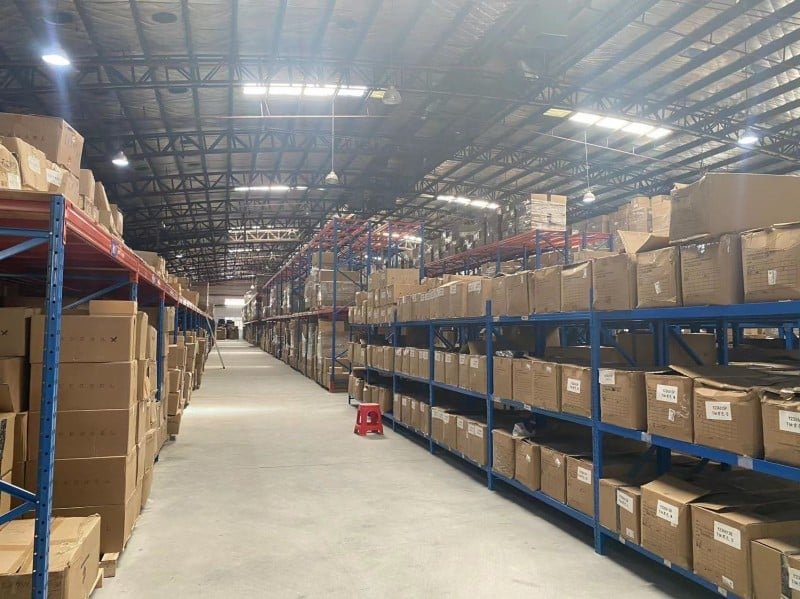
Subscription scaling will require centralized inventory management in a dedicated warehouse where it is possible to receive goods in large quantities, dedicated zones of assembling kits, and simplified multi-channel delivery.
It is compatible with packaging customization – branded inserts, themed fillers and enables returns to be consolidated to be reviewed and returned more quickly. In cases of brands with their sources in Asia, a China fulfillment center such as those provided by specialization partners have a considerable drop in inventory hold onto expenses because they help minimize transit durations and add batch kitting performance. This association offers scalability flexibility of recurring cycles and brands are able to manage the fluctuation in traffic without the proportional growth of cost.
Cost Structure of Subscription Fulfillment
The fulfillment cost structure of subscription models differs significantly from traditional ecommerce owing to assembly costs and cycle-specific costs.
The assembly work usually surpasses normal picking because of the involvement of kitting, whereas custom packaging incurs repetitive material expenses.
| Cost Component | Impact |
| Labor | Higher than standard DTC (kitting intensive) |
| Packaging | Custom + recurring usage |
| Storage | Predictable but volume-sensitive |
| Shipping | Batch optimized, but cycle-timed |
| Returns handling | Lower volume but sensitive to accuracy |
These expenses are dependent on the number of subscribers and level of customization and as such proper forecasting is essential in ensuring good margins.
Common Mistakes Subscription Brands Make
Another cause of inefficiencies that can be avoided is that subscription brands often underestimate the operational requirements of their model.
- Ignoring churn effect on predictions and leaving this to chronically overstock and idle capital.
- Poor planning of SKU rotation that leads to bored or redundant products that aggravate the subscribers.
- Calculating kitting labor requirements too low, which causes in the batch windows.
- There was no batch scheduling system that led to disorderly assembly and ship schedule failure.
- Assuring fast delivery when there are no cycle buffers, damaged confidence in case of delays.
These problems increase and become problematic as time goes by making manageable operations drivers of churn.
Conclusion — Subscription Fulfillment Is a System, Not a Warehouse Task
Shipment Subscription box fulfillment is not a twist of ecommerce shipping, it is an integrated operational system balancing the demand with periodicity, curated product assembly, and inventory risk based on churn.
Kitting accuracy retention: consistency of quality are offered. Profitability is safeguarded by frequent forecasting in proper procurement. Churn management is used in all upstream decisions, such as safety stock or order to suppliers. The design of the warehouse should reflect the following realities: specific areas, systems and process driven cycles.
Brands whose fulfillment is more of a strategic system than a tactical operation prospectively and profitably and operational excellence is transformed into a competitive advantage that is financial and long term.