Find out all about the export licenses and import licenses, their types, and requirements set by the department, as well as how to apply arms regulations. Make sure that your company is operating in accordance with the U.S. export laws, avoiding any potential restrictions.
Introduction
Did you realize that 95 percent of the U.S. exports need no license? But what about the other 5% that require an export license as defined by a licensing agency? To companies that are expanding into international markets, that small percentage can make or break their plans to expand. Knowledge of export licenses is very important to a business that wants to venture into international trafficking. This is a guide that will decompose all you want to know about export license requirements, application procedures, and compliance measures.
What Is an Export License?
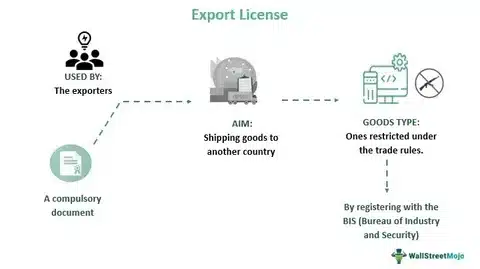
Export license—this is a government license that allows the exportation of certain goods or services from one country to another. Just consider it a passport to your products, without which some products would not legally be able to be exported across international borders with a company identification number.
Export licenses are mainly used to control export control compliance, especially when certain exports require special handling with national security, foreign policy, and economic interests. These laws assist the governments in regulating the circulation of sensitive technologies, safeguard the domestic industries, and sustain international relations.
The export licensing and import license are administered by the state’s directorate and other important agencies under the United States government in the United States, including various government departments and border protection.
- Bureau of Industry and Security (BIS): Governs dual-use products, which can be utilized by both civilians and the military.
- Directorate of Defense Trade Controls (DDTC): Monitors articles and services pertaining to defense.
Types of Export Licenses
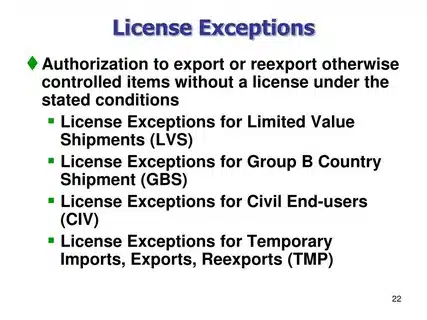
The various types of export licenses assist in establishing the type of permit that is relevant to your business:
Individual Validated License (IVL): It is the most widespread one and is intended to be used in particular transactions between specific parties. A license is only valid for one export or related transactions to a single end-user.
General License: Includes various transactions under some predefined terms. These are wider permits where exports are made without having to seek individual licenses as long as certain requirements are satisfied for biological weapons.
Temporary License: It is one that is intended for short-term exports; this is usually done on products that will be shipped back to the United States within a given period. Typical examples are trade show equipment, demonstration equipment, or temporary repair equipment for exporting items.
Global License: This is best suited for firms that have repeated exports to numerous destinations. The option makes compliance oversight with reduced administrative responsibility on the frequent exporters’ BIS website.
Encryption License: This license is only necessary with software or technology having encryption capabilities. These licenses are further examined and made to meet certain technical specifications for dual-use items because cryptography technology is sensitive.
Do You Need an Export License?
The decision on whether to use an export license or not depends on four crucial factors and may involve contacting licensing agencies for guidance :
Product Classification: The initial requirement is to determine whether your product’s export control classification number is listed on the Commerce Control List (CCL). It contains a complete database of items that are classified according to their possible dual use and sensitivity.
Destination Country: This is to consider whether you are exporting to the countries that are under U.S. sanctions or embargoes. There are destinations that bear restrictions that automatically activate licensing requirements irrespective of the nature of the product.
End User: Ensure that you do not see your recipient on restricted entity lists related to items exported, and also consider the end use of the goods. The U.S. government keeps a number of databases of companies and people that are not permitted to receive some of its exports.
End Use: Review how your product will be used, keeping in mind the relevant regulations that apply. Goods that are to be used for military or dual purposes might be subject to further inspection and licensing, although they would otherwise not need to be licensed to be used by civilians.
How to Apply for an Export License
Application process Export license application procedure works systematically via the SNAP-R application process, which allows you to apply online :
Step 1: Deciding whether or not your product needs to be licensed based on the Export Administration Regulations (EAR) and examining control lists.
Step 2: Export Control Classification Number (ECCN) should be used to classify your product. This alphanumeric code represents the status of the control of your product and assists in identifying the licensing requirements.
Step 3: Use the Simplified Network Application Process Redesign (SNAP-R) system, the government system of online export license application.
Step 4: Have a detailed documentation, i.e., product specification, end-user information, intended use statements, and destination country. The completeness and accuracy will avoid time loss in the future.
Step 5: Wait for approval. The average approval time is several weeks, although this can be longer with complex applications or sensitive technologies. You have to plan and apply early enough before the date you want to export or before your desired date.
Common Pitfalls to Avoid
You can learn how to save your business time and money by learning how other people made their mistakes, especially regarding trade restrictions :
Misclassification: This is one of the most common mistakes where the issue of licensing is wrongly determined. As a precaution, we can refer to the export compliance professionals or approach the government agency in question directly.
Lack of Documentation: Lack of documentation, including a commercial invoice or inaccurate information on applications, leads to a great deal of delays. Proofread everything and make sure that your application is a perfect match with supporting documentation.
Violating Sanctions: The process of exporting to a prohibited country or entity could be subject to very harsh consequences. Frequently consult sanctions lists, which evolve quite often depending on the geopolitical events.
Late Applications: Applications should be submitted early enough to avoid this unnecessary pressure, which may lead to lost business opportunities. The licensing process can be initiated early enough to allow for possible delays or demands for further information.
Case Studies
Case Study 1: TechFlow Solutions, an IT firm, had to export its new cybersecurity platform to European customers. Through appropriate categorization of their encryption technology and collaboration with compliance experts, they were able to attain the required encryption license in six weeks. Their initiative to classify ECCN proactively and comprehensively in their documentation avoided procrastination, and they were able to access their international launch deadline.
Case Study 2: Precision Manufacturing was facing a lot of delays when trying to file a license to export a machine of specified specifications. Their first use was not of technical specifications and full details of its end-user. This back and forth with licensing bodies made them export their products three months late, which cost them a big contract. This taught me that proper preparation and documentation at the very beginning are important.
Conclusion
Export licensing is not as complicated as it may appear, and knowing the export regulations’ basics keeps your business on the safe side of laws and regulations.and at the same time exposes it to international markets. It is important to remember that 95% of exports do not need licensing, and due diligence would make sure that certain exports are compliant with the regulations about the 5 percent that do receive it.
The main insights into effective export compliance are that the product should be properly classified, the destination and end-user screened, the documents of the application should be complete, and the licensing timeline should be planned in advance. With these rules, access to the means, and guidance from government agencies, your company will be able to safely enter the international market without breaking any regulations.
Investment in knowledge of the process of obtaining an export license will pay itself off in the form of low risk, even in the case of nuclear materials, quick market penetration, and good relations with the foreign partners appreciating business conduct that complies with traditions.