
Uncategorized

Import from Mexico wooden crate lifted by forklift for shipment.
Uncategorized

Import from Mexico: Your Complete Guide to Cross-Border Trade Success

This over-the-counter guide includes the key elements of importation in Mexico with reference to the fact that the U.S. imported 505.9 billion Mexican goods in 2024 and the strategic benefits of losing the USMCA trade agreement. Some of the important issues that one can get to know are the knowledge of the most popular export goods, automotive, electronics, and agricultural products, the legal requirements and documentation, the logistics which can be managed in trucking, rail, ocean, and air transportation, the optimization of duties and taxes due to the correct classification and origin, how to cooperate with a customs broker, and how not to get into a trap that would result in delays and extra expenses. The guide stresses that successful import operations must be built based on proper preparation, regulatory compliance, and a good relationship with suppliers in Mexico.

Export license document template with importer, exporter, contract, and goods details.
Uncategorized

What Is an Export License

An export license is an official government authorization that allows a business or individual to ship specific goods, technology, or software to another country. It is required when the items being exported are restricted for reasons such as national security, foreign policy, trade protection, or controlled use in sensitive industries. While many everyday products don’t need a license, certain categories—like military equipment, high-tech electronics, or dual-use goods—often do. Exporters must check the regulations of both their home country and the destination to avoid legal issues, delays, or penalties.

Printed Amazon FBA box label affixed to cardboard carton showing box number and warehouse address
Uncategorized

Amazon FBA Box Label: Complete Guide 2025

This comprehensive guide covers everything Amazon FBA sellers need to know about proper box labeling in 2025, from understanding the different types of required labels (FBA shipment/ID labels and carrier labels) to exact printing specifications and placement guidelines. Key success factors include using appropriate printing equipment with a minimum 300 DPI resolution, positioning labels on flat surfaces away from edges and seams, removing old labels from reused boxes, and implementing quality control systems to catch errors before shipping. Sellers can choose between in-house labeling for control and cost savings or outsourcing to suppliers, 3PLs, or freight forwarders for professional expertise, with each approach offering distinct advantages depending on business size and complexity. The guide emphasizes avoiding common mistakes like poor print quality, incorrect information, and improper placement while staying current with Amazon’s evolving requirements and regional compliance variations to ensure smooth FBA operations.

Completed customs clearance stamp on package confirming successful inspection
Uncategorized

Cleared from Customs: Your Complete Guide to International Shipping Success

Customs clearance describes the way that the overseas packages are checked out and treated by the authorities of the destination before the final delivery. The success is based on some correct documentation, correct value declaration, correct packaging, and destination country regulations. Express services are more expensive and have faster clearance, but standard services are cheaper and time-consuming. Delays usually occur due to incomplete documents, underestimated statements, or limited goods. Adhering to best practices in documentation, packaging, and selection of services, shippers can reduce the duration of clearance and eliminate extra costs, and guarantee that packages attain the status of “cleared by customs” in a short time and move to their final destination.

Person delivering Amazon boxes and padded mailer to customer doorstep
Uncategorized

Amazon Packaging Requirements: Complete Guide for 2025

The 2025 Amazon packaging requirements ensure that all products sent to FBA are safely packed, properly labeled, and easy to process. Boxes must meet size and weight limits, be sturdy enough to pass a drop test, and protect items with approved materials like bubble wrap or polybags (with suffocation warnings when required). Each unit needs a scannable FNSKU barcode, and shipping cartons must carry clear Box ID and carrier labels. Amazon also enforces product-specific rules for sets, fragile items, and sharp goods, while banning loose fillers like packing peanuts. Non-compliance can lead to delays, extra fees, or rejected shipments, so following these standards helps sellers keep their inventory moving smoothly.

Brown cardboard packages labeled clearance sale in a shopping cart representing imported goods ready for custom duty clearance
Uncategorized

What Is Custom Duty Clearance? A Complete Guide for Importers & Exporters

The clearance of customs is a complicated yet easy-to-manage task, which should be well documented, product-classification-wise, and adhere to the regulations of the destination country. To succeed, one has to be well prepared, seek the advice of professionals where necessary, and keep up with the emerging world of trade expectations. With such knowledge of the customs brokerage firm process, the prevention of typical errors, and the use of the offered technology and trade agreements, companies can reduce costs and time losses, as well as make sure that their international affairs are legal.

Aerial view of large China shipping port used for express freight services
Uncategorized

Express Shipping from China: Your Complete Guide to Fast Delivery Solutions

Chinese express shipping offers businesses the 1-5 day delivery option as opposed to the 2-6 weeks of normal delivery, but at 3-5 times the price. To balance the needs of urgency and its effects on costs for express shipping companies, success demands the selection of reliable providers who have good Chinese connections for timely delivery to the final destination with proper documentation and strategic planning. Although premium pricing renders express freight inappropriate in regular shipments, it is necessary in urgent deliveries, critical business processes, and those in which the cost of delay is greater than the shipping premiums or air freight costs. The best way to maximize the use of express freight is through establishing relationships with the providers early in advance, keeping accurate records, liaising with suppliers, and putting up backup plans in advance before the need becomes imperative for the supply chain.

Visual EXW chart explaining cost, risk transfer, and responsibilities for buyers and sellers.
Uncategorized

Ex Works Price: Complete Guide to EXW Incoterms

The simplest Incoterm is Ex-Works (EXW) pricing, where sellers ship their goods from their facility, and buyers take all the transportation, documentation, and risk costs from that point onwards. Whereas the EXW provides sellers with low risks and low administrative overhead, it places the burden of the complex international logistics on the buyers. The key to successful EXW terms is proper specification of the contract, understanding of the export requirements, good logistics relationships and cost planning, and covering all expenditures between the factory gate and destination. Use EXW when you possess good logistics and wish to exert the greatest influence on the transportation process, but take a more inclusive Incoterm when you wish to have a less complicated procurement process with unsurprising overall prices.

Courier delivering a large package to a customer’s doorstep.
Uncategorized

Door-to-Door Shipping Explained: How It Works, Terms, Costs, and Best Practices

Door-to-door shipping is a logistics service where goods are picked up directly from the seller’s location and delivered straight to the buyer’s address, covering every step of the journey under one arrangement. This method simplifies international trade by combining multiple transport modes—such as trucking, sea freight, and air freight—into a seamless process managed by a single provider. While it is often more convenient for buyers, costs can vary depending on distance, shipment size, customs duties, and value-added services. Key terms and documents, including Incoterms, invoices, and customs paperwork, must be understood to avoid delays. Best practices include choosing experienced freight forwarders, ensuring proper packaging, verifying duties and taxes upfront, and maintaining clear communication to guarantee smooth and efficient delivery.
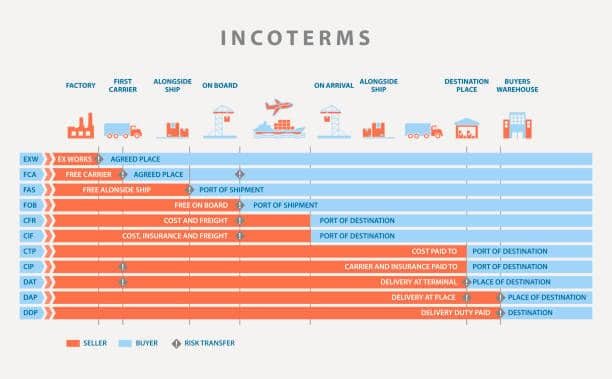
Complete Incoterms chart outlining cost, duty, and risk transfer stages from factory to buyer under different shipping terms including DDP.
Uncategorized

DDP Shipping: A Complete Guide

DDP (Delivered Duty Paid) shipping is an Incoterm where the seller takes on maximum responsibility, covering all costs and risks until the goods reach the buyer’s destination. This includes transportation, export and import duties, customs clearance, and taxes, making it a highly convenient option for buyers who receive goods without extra logistical burdens. However, it places heavy obligations on sellers, who must manage compliance with foreign regulations and potentially face unexpected costs. DDP is often used in e-commerce and cross-border trade to simplify the buying experience, but it requires careful planning, reliable logistics partners, and a clear understanding of local tax laws to avoid delays or losses.

Scroll to Top

GET A QUOTE