
Warehousing service charges are not fixed they are dependent on the size of storage, complexity of handling, and order quantity and fulfillment. The price of warehousing services offered by many businesses is often anticipated to be flat, whereas in actual situations, costs tend to be dynamic and depend on various operational factors.
Having worked with eCommerce sellers, dropshippers, and import businesses, the overall cost is usually quite surprising to first-time users since it is a mix of multiple usage-based factors and not a single monthly charge. Knowing these elements would enable you to budget correctly and prevent the occurrence of unforeseen expenses which may gnash profits.
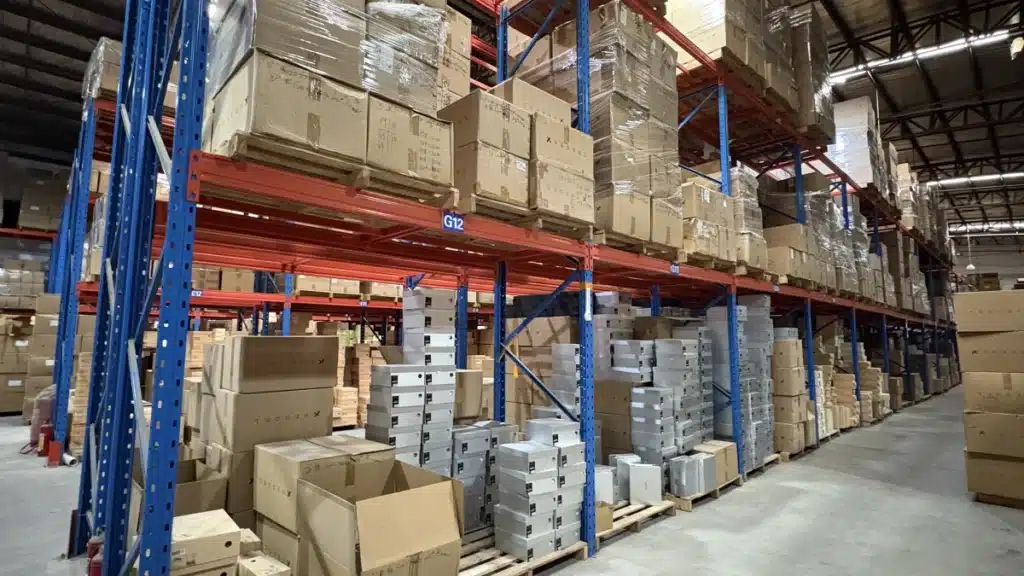
Average Warehousing Costs Overview
Average warehousing services cost a few dollars per order in fulfillment heavy systems to $2045 per pallet per month storage depending on the location, volume and level of service. Pricing is very flexible and usage based, implying that small businesses with low inventory can pay very little as compared to high volume Amazon or Shopify sellers.
The following is a brief overview of the most common cost structure:
| Cost Type | Pricing Method | Typical Range (2026) |
| Storage | Per pallet / CBM / bin | $15–45 per pallet/month; $0.45–2.00 per cu ft/month |
| Handling | Per inbound/outbound | $25–50 per pallet received |
| Pick & Pack | Per order / per item | $2.50–8.00 per standard order |
| Shipping | Based on weight and distance | Carrier rates + handling fee |
These numbers are used as broad guidelines based on industry surveys and actual 3PL operations. Depending on the nature of your product, the location of your warehouse and the terms that you have negotiated, actual costs can change.
Main Components of Warehousing Service Costs
The actual warehousing services cost can be divided into various parts which are different but related to one another. Companies that consider logistics costs tend to pay close attention to warehouse storage costs to gain more insight into the pricing.
The following is what each of these components usually comprises:
| Cost Component | Description |
| Storage | Space usage over time (monthly billing) |
| Receiving | Handling inbound goods (unloading, inspection) |
| Pick & Pack | Preparing orders for shipment |
| Packaging | Materials and labor for boxing or custom packs |
| Shipping Coordination | Delivery cost management and carrier handoff |
Storage is generally the biggest continuing cost. It is billed by pallet position (easy with bulk items), cubic feet (more precise with mixed SKUs), or bin/shelf space (perfect with small items).
Receiving involves unloading containers, tallying products, and storing. The charges are usually per pallet or carton with an additional charge on the poorly prepared goods.
Picking and packing is the process of finding items, compiling orders and getting them ready to be shipped. The vast majority of providers have a minimum fee and additional items that are somewhat smaller.
Boxes, bubble wrap, labels, or custom materials are added to packaging when the standard ones are inadequate.
Shipping coordination generates labels and integrates carriers, but shipping charges are paid to the carrier.
Factors That Influence Warehousing Costs
A number of operational variables influence the cost of the warehouse far much more than any base rate. The large volume business of a product tends to have cheaper per-unit prices as compared to those with a large number of SKUs or slow moving inventory.
Key factors include:
| Factor | Impact on Cost |
| Inventory Volume | More space required = higher total cost |
| SKU Count | More complexity in picking and storage |
| Order Volume | Higher volume may reduce unit cost through efficiency |
| Storage Duration | Longer holding periods = more expensive |
| Value-Added Services | Custom labeling, kitting, or assembly adds fees |
Location is a significant factor as well. The warehouses around large ports or city clusters tend to be more expensive since the real estate and labor expenses are higher, whereas the strategic location in the inexpensive areas can provide significant savings without compromising the quality of services.
Warehousing Pricing Models Explained
Warehousing companies have varied pricing schemes to suit different business requirements. There is no universal model to apply to all operations and the appropriate choice will be made depending on your inventory profile and order patterns.
Common models include:
| Model | Best For | Advantage |
| Per CBM | Flexible or loose goods | Pay for actual usage |
| Per Pallet | Bulk storage | Simple and predictable pricing |
| Per Order | eCommerce fulfillment | Scales directly with sales |
| Subscription | Stable, predictable volume | More predictable monthly expense |
Per-pallet and per-CBM models are suitable in businesses whose levels of inventory are constant. Per-order pricing is appropriate to fast moving eCommerce sellers since the cost varies with real sales. With predictable throughput, subscription-type arrangements can offer stability to the budget of companies.
Hidden Warehousing Costs to Watch Out For
Although the base rates are transparent, there are other hidden or variable charges that can make you pay a lot more than you expect to pay in terms of warehousing services.
Common ones include:
- Returns processing – Customers returns are usually charged with distinct labor and restocking costs.
- Labeling or repacking cost- Labeling or repacking products that do not come with appropriate labels or require specialized labels.
- Special handling – Fragile, oversized or hazardous.
- Long-term storage charges – During periods longer than contracted inventory in place.
- Peak season changes – Seasonal rates that get raised during peak times such as holidays.
These surprises can be avoided by going through the fine print and requesting a comprehensive fee schedule ahead of time.
How to Estimate Your Warehousing Cost
The first step to estimating your own warehouse cost is to collect some basic operational statistics. Start by finding your average monthly inventory measurements in pallets, CBM or cubic feet. Then multiply with the storage rate of the provider.
Then, approximate monthly order volume and average items per order to estimate pick-and-pack charges. Add anticipated inbound receiving costs, depending on frequency and size of shipments. Lastly, include any value add services that you may require.
One of the simplest formulas that many logistics planners apply looks like the following:
Estimated Monthly Cost = (Storage fee x space occupied) + (Receiving fee x inbound volume) + (Pick and pack fee x orders) + Packaging and Other services.
The reality provided by running scenarios of low, average, and high-volume months is a range of numbers as opposed to one fixed number.

How to Reduce Warehousing Costs
Wise business decisions can significantly reduce your total cost without compromising service delivery. Practical measures that have been suggested by supply chain teams that have gone through it include:
- Enhance inventory turnover through a better forecasting of demand and decrease in slow moving inventory.
- Optimize the packaging to reduce material usage as well as the dimensional weight charges.
- Select scalable cost models that match actual activity rather than set commitments.
- Bring together shipments and contact carriers with volume discounts on your behalf via your warehouse partner.
- Periodically analyze storage use to get rid of deadstock and release paid space.
A lot of companies also find it profitable to collaborate with the providers who provide free or cheap initial storage and sophisticated inventory visibility solutions.
Conclusion — Warehousing Cost Depends on Operations
Various operational variables affect the warehousing costs and companies that are aware of such variables are able to make better decisions, manage their expenses and enhance the efficiency of logistics.
Instead of trying to find the lowest cost model, look at the model and partner that fits best to your particular inventory behavior, order patterns, and growth plans. Using accessible statistics and a proactive management approach, warehousing services can be a manageable component of your supply chain instead of an unforeseeable cost.